April 3, 2007

Is There a Future for Bibliographic Databases?

A week or so ago, Michael Cairns of the wonderful new-to-me blog PersonaNonData asked me if I would like to write a guest post on his blog. Inspired by my My Job in 10 Years series he wondered what I thought about the future of bibliographic databases such as Books in Print and WorldCat.

Of course, I was more than happy to rev up my crystal ball and take it for a spin around the block.

Here's a little excerpt from my guest post:

Here's how he put it in his email:
I have read your posts on the future of information databases and bibliographies etc. over the past several months and I was wondering whether you had a specific opinion of the future of bibliographic databases such as worldcat and booksinprint? ... [O]n my blog I have skirted around the idea that the basic logic of these types of databases is beginning to erode as base level metadata is more readily available and of sufficient quality to reduce the need for these types of bibliographic databases. Assuming that is increasingly the case then these providers need to determine new value propositions for their customers. So what are they?

How could I resist...

Enjoy the full post here.

I would like to thank Michael for this wonderful opportunity and I hope to be able to return the favour one of these days. I'll leave the post on PersonaNonData exclusively for a week or two and then I'll repost it here for the sake of completeness. I do consider the post to be related to the 10 Years series and I'll be including it in the collected version pdf as an appendix of some sort the next time I recreate it.

April 2, 2007

Update on Kathy Sierra story

Following up on my post from last week, here's an update on Kathy Sierra's situation from her blog. As well, it's useful to read Chris Locke's post where he talks about his lack of involvement in the threats. Tim O'Reilly acted as a mediator between the two, and this is his take on the situation.

Locke and Sierra have issued a joint statement on Locke site. This is Locke's intro to the joint statement:

It's still April Fools Day as I write this, but this page is not a joke. Kathy Sierra and I (Chris Locke) agreed to publish these statements in advance of the story which will appear tomorrow (Monday 2 April 2007) on CNN, sometime between 6 and 9am on "CNN American Morning." As used in the somewhat Victorian title slug, above, "coordinated" is meant to signal our joint effort to get this stuff online, not that we co-wrote the material you see here, or had any hand in prompting or editing each other's words. We hope something new comes through in these statements, and that they will perhaps suggest more creative ways of approaching the kind of debate that has been generated around "the recent events" they relate to. For anyone who is newly arrived from another planet, and is therefore unfamiliar with those events, Kathy's initial post is here, and my initial reaction is here. It is not optimal that this page is hosted on rageboy.com, as my questionable nom de plume has been part of the debate, but time was short and this domain was the most available for the purpose.

It's an interesting joint statement, one that I hope you all read. I hope that the lesson we all learn from this is that the social networks that we have created are living, vital and dynamic things, that are alive and evolving at a crazy pace. As much as we celebrate the wonderful things that rise up from the primordial ooze, we also have to face down the bad. Hopefully, the kind of dialogue that Sierra and Locke have been able to build up is a sign that we can face those demons and make the web a safe, friendlier place for everyone.

I'd like to end with a series of points for a Blogger Code of Conduct that O'Reilly proposes in the post I link to above. It's a code that I can live with and that we can all take to heart.

  1. Take responsibility not just for your own words, but for the comments you allow on your blog.
  2. Label your tolerance level for abusive comments.
  3. Consider eliminating anonymous comments.
  4. Ignore the trolls.
  5. Take the conversation offline, and talk directly, or find an intermediary who can do so.
  6. If you know someone who is behaving badly, tell them so.
  7. Don't say anything online that you wouldn't say in person.

Where should I post my science book reviews

Update: Last day to vote!

As most of you have no doubt noticed, I have been doing pretty regular science book reviews these last several months (I'm currentlly working on the review of Struck by Lightning by Jeffrey Rosenthal). My practice has been to post the text of the review on my regular reading diary blog and link to that review here. My reasoning for this arrangement was two fold. Mostly I thought it was a good idea to keep all my book reviews together in one place, whether they be reviews of sf novels or popular science books, one stop shopping for my book reviews. The other reason was to try and direct a bit more traffic over to the other blog. I get about a fifth to a tenth of the traffic there that I do here and I figured I'd spread the love a little more evenly.

I've been thinking about this arrangement a bit the last few weeks and I'm no longer sure it reflects my current desires. First of all, I used to see my science book reviewing as quite peripheral to my main mission, an amusing sideline; now I see it more closely related to that mission: to better understand science, (budding) scientists and the culture of science with the idea that with better understanding comes a better level of library service. And as far as traffic is concerned, to the extent that I care about it at all, the traffic that I care about is the traffic here. It's the other blog that's the amusing sideline.

So, what to do? In the spirit of fun, I thought I'd run a little poll and let you, my faithful readers, decide what I should do. I can either maintain the status quo and post the reviews to the other blog with a link here, do the reverse and post the full text here and a link from the other blog or just post the full text in both places and be done with it.

Have I already decided? Not by a long shot. I'm certainly open to the idea that my readers aren't that interested in my book reviews and want them off to the side. I'm also open to the idea that my readers would like to be able to see the reviews in their feed readers without jumping to another blog.

Let me know what you think, either by voting or a comment or both. I'll give it a couple of weeks before closing the poll. I'll also put this post on top a couple of times during that period.


Where should I post my science book reviews?
Full text on Reading Diary, link here (ie. status quo)
Full text here, link on Reading Diary
Full text on both blogs
  
Free polls from Pollhost.com


Update 2007.03.23: changed post date to current date.

March 29, 2007

The week in carnivals

Two new carnivals this week:

Friday Fun: World Horror Convention

I'll be at the 2007 World Horror Convention here in Toronto for the next couple of days, so I thought I'd do my Friday posts a day early.

To commemorate the con, let's all take a stroll down to Lovecraft's 70th death-a-versary, Cthulhu adoration everywhere at BoingBoing and enjoy some good ole Lovecraftian creepiness. Also amusing at Flickr are all the Cthulhu photos!

Ph'nglui mglw'nafh Cthulhu R'lyeh wgah'nagl fhtagn!

(Quote from Wikipedia, of course. And check out how many google hits that phrase gets. The web is one very strange place.)

Toxic service

Via SlashFood, a post by an anonymous Starbucks barista, on how much he has nothing but disdain and contempt for his customers. It's actually pretty funny, in a sick sort of way, and there's quite a bit I can identify with from my time at the reference desk. People can be weird, stupid, rude, clueless and every other thing you can mention. On the other hand, I've had a couple of bad days over the years too, we all have. But, I always try and catch myself when I'm a bit less service-oriented than I should be. We're all human, right? We all like sharing clueless user stories around the campfire. And we've probably all been less than perfect on the other side of the desk on occasion as well.

But I have to know that this anonymous barista is a terrible barista and probably just a rude and unpleasant person, that his customers can see the contempt dripping from him, oozing from his every word and gesture, that he wears his feelings of entitlement and superiority on his sleeve for all to see. You can't hide it forever.

I like to use rants like this as a way of reminding myself to be at my best when I'm helping people, to have a bit of patience and empathy (and really this guy has none), to treat people like I'd like to be treated, to see the world through their eyes.

It also helps to be on sabbatical and not having sat at a reference desk in something like 8 or 10 months ;-)

Libraries at the Cutting Edge

Libraries at the Cutting Edge by By Pamela Snelson, president of the ACRL, appears in today's InsideHigherEd.

The trendiest meeting place on many college campuses these days features a coffee bar, wireless Internet zones, free entertainment and special programs, modern lounge areas and meeting rooms.

And free access to books. Lots of books.

This educational social hub is the campus library, which is beginning to look more like an Internet café than the academic library you remember from your college days.

It's all pretty standard stuff, from our insider point of view, but it's nice to see it articulated in a venue like InsideHigherEd where faculty can be reminded that even though they haven't stepped into the library in a while, their students still do.

InsideHigherEd often has these very positive library-related articles, which is something I very much appreciate.

March 26, 2007

O brave new world, that has such people in't!

Welcome to Web 2.0. Welcome to the social web.

Via Walt, the kind of thing that's sadly all too common on the web these days. Cyberbullying, and racism I knew about, but death threats against bloggers!

It seems that Kathy Sierra of Creating Passionate Users has been subject to some very serious death threats from commenters on her blog and other blogs.

As I type this, I am supposed to be in San Diego, delivering a workshop at the ETech conference. But I'm not. I'm at home, with the doors locked, terrified. For the last four weeks, I've been getting death threat comments on this blog. But that's not what pushed me over the edge. What finally did it was some disturbing threats of violence and sex posted on two other blogs... blogs authored and/or owned by a group that includes prominent bloggers. People you've probably heard of. People like respected Cluetrain Manifesto co-author Chris Locke (aka Rageboy).

*snip*

I do not want to be part of a culture--the Blogosphere--where this is considered acceptable. Where the price for being a blogger is kevlar-coated skin and daughters who are tough enough to not have their "widdy biddy sensibilities offended" when they see their own mother Photoshopped into nothing more than an objectified sexual orifice, possibly suffocated as part of some sexual fetish. (And of course all coming on the heels of more explicit threats)

This is what Robert Scoble has to say on his blog, Scobleizer.
The Internet culture is really disgusting. Today when I was on Justin.TV the kinds of things that people were discussing in the chat room there were just totally disgusting and over the top.

*snip*

It’s this culture of attacking women that has especially got to stop. I really don’t care if you attack me. I take those attacks in stride. But, whenever I post a video of a female technologist there invariably are snide remarks about body parts and other things that simply wouldn’t happen if the interviewee were a man.

It makes me realize just how ascerbic this industry and culture are toward women. This just makes me ill.

I agree 100% with Robert. This makes me physically sick.

The issue that concerns us here, of course, is that we, as librarians, as educators, we want to build social spaces where people can interact, learn, have fun, be themselves and maybe even grow up a bit. The problem is, how do we keep the creeps from ruining it for everyone? Because you know, I know, we all know, that if this happened on one of our systems it would become a campus-wide issue, that the library would suddenly become the focus of a lot of not-so-great attention. Eventhough most of the systems we build will probably have login/authentication, we can't just brush this kind of thing off; when we implement social systems we have to have a plan for (hopefully) preventing this kind of thing and have a plan for dealing with the fallout when in inevitably does.

(Of course, Web 2.0 is also the best thing ever. It was trivial for me to find the Shakespeare quote that's the title of this post using Google to find the Wikipedia page of Shakespeare quotes the Huxley's Brave New World.)

Computational Complexity's Lance Fortnow calls it a day

One of my favourite CS blogs, Lance Fortnow's Computational Complexity, is coming to an end. I've always really appreciated Fortnow's insights into the world of CS and have often linked to him here. I'll miss him in the blogosphere, and I hope he finds a way back in one of these days, perhaps after and extended break to recharge his batteries. Thanks for everything, Lance!

The Blogerati Files: easternblot.net

Eva Amsen of Toronto science blog easterblot.net has just been interviewed on the BlogTO site.

It's a fun interview, more on general Toronto culture rather than any a real probing of science-bloggy proportions. My favourite little exerpt:

I started easternblot because I got frustrated with people thinking of science as something alien and difficult, while it's actually so common. Food, sports, social interactions, and movies all have some science behind them that we just don't tend to think of as "science". I wanted to give the science of daily life some attention, especially for people who claim they don't like or understand science. At the same time, a lot of art is science-inspired, and I also write about that.

We also find out where the name of her blog came from.

One strange little factoid about the interview is that they don't actually mention her name anywhere. I mean, she's not anonymous by any means, so it is very odd.

Leadership

From David Suzuki's latest Science Matters column: Wanted: Leadership for the 21st Century:

Politicians have a much shorter lifespan - politically speaking, that is. They can be around for four years or less. Rarely more than eight. That's why I'm often surprised by how little they seem to want to accomplish in that time. Certainly, I understand the lure of the status quo. Change is hard. Often vested interests will fight you every step of the way. Political advisors will say "No, no, no - stay the course! Don't make waves! Get re-elected!"

But what's the point of being re-elected if you aren't going to DO anything? Yes, yes, maybe I'm being naïve. Maybe politicians are just there to support their vested interests, take home a fat paycheck and pension, and revel in the power of their office. But surely there's got to be more to it than that? The life of a politician is not one I envy. It's hard, sometimes brutal. You are constantly under scrutiny. You are always on the job. It takes up your entire life.

That's why I honestly believe that most politicians at least start out wanting to work for the common good. Many become overwhelmed by the muck, but great leaders act. They make bold decisions and move on them. They don't tinker when big changes are needed and they don't change things just for the sake of change. One of my pet peeves is the way some administrations will move into office and, rather than take an honest assessment of what's working and what isn't, instead set out to dismantle everything the previous administration had done just to make a point.

Of course, it's hard for leaders to act without public support. But right now, the environment is the top public concern. The public will support strong environmental leadership, so now's the time for our political leaders to act.

Of course, he's talking about politicians dealing with environmental problems, combatting global warming. But he could just as easily be talking about leaders in academic libraries coming to grips with the changes happening in our world. Just change the word "politician" for "librarian" or "library administrator" and a few other substitutions and it would be a perfect fit. It can be hard to go from thought to action, to get consensus, to break down resistence. But I think if we work from the assumption that people actually want to do the right thing, that they just don't know how to get there, that they just need to know where their place is in the brave new world, it's a lot easier to get the job done.

March 23, 2007

The week in carnivals

Two weeks in science & library-related carnivals:

Balanced Libraries: Thoughts on Continuity and Change by Walt Crawford

Walt Crawford has finally announced the title of his new book: Balanced Libraries: Thoughts on Continuity and Change.

A library system that stands still is unbalanced and headed for trouble. A library staff obsessed with Hot New Things and aiming for new users at the expense of familiar services and existing patrons is unbalanced and headed for trouble. Very few libraries fall into either extreme, but sometimes it seems as though we’re urged toward one extreme. This book grew, indirectly, out of discussions surrounding and emanating from “Library 2.0”—the ideas, the set of initiatives and the term itself. I believe those discussions have shifted toward more balanced approaches. This book aims to develop and continue those discussions. It is divided into three sections, not including the first and last two chapters. Three chapters discuss the library and its community. Four chapters discuss barriers to change. The remainder of the book discusses positive aspects of change.

It look very interesting; I've already ordered my copy and I can't wait to read it. It's self-published via POD company Lulu.com; from my experience with the Open Laboratories book (Lulu page) I can say that their books look great -- basically the same as high quality trade paperbacks.

I expect this book to get quite a good buzz in the biblioblogosphere as Walt is one of the most sensible yet no-holds-barred commentators in the library world. And I'm not just saying this because I'm cited three times in the bibliography ;-)

Update 2007.04.11:
The book arrived yesterday, Tuesday, April 10th. I ordered it on March 22nd, so that gives an idea of how long it takes to make it to Canada, give or take a couple of days due to the long Easter weekend with no mail delivery. Shipping was us$7.58, tax us$1.75 for a total of us$30.83. I haven't received my credit card bill yet for the total in cdn$, but I'll update here when it arrives. Physically, the book looks terrific and I can't wait to read it; I might take it along to Computers in Libraries.

Friday Fun: The Future of Web 2.0

LOL! Really, this stuff is just too funny for words. Take a look at The Future of Web 2.0 by Nat Torkington over at O'Reilly Radar:

2009: The fascination with widgets leads Firefox 4 to integrate with the native operating system's desktop to offer a new cross-platform widget environment. Out of respect for the diligent workers still building the Semantic Web, it is agreed that we'll reserve "3.0" for their work. Bloggers skip that number and go straight to Web 3.1.

And on, and on, and on, you will see the advent of Web 286, Web 3.1, Web NT, Web 95, Web 98, Web XP and Web Vista. What, no Web ME? (The scary thing is, the first Windows I used was the pre-3.1 version, which I thought really sucked big time. I was a pretty dedicated command line guy until Win 95. I also used to prefer WordStar to Word.)

March 22, 2007

Three on Computer Science

  • Eugene Wallingford has a bunch of posts on the recent SIGCSE (Computer Science Education) conference:
    I haven't gotten through that much of it yet (this is a very in depth conference report!), I can say that what I have read is great. Lots of insight into the challenges of teaching CS.

  • ACM PROGRAMMING CONTEST SHOWCASES TOP TECH TALENT FROM AROUND THE WORLD and the results are in. Here's a snippet from the press release:
    The top five winners were Warsaw University (Poland), Tsinghua University (China), St. Petersburg University of IT, Mechanics and Optics (Russia), Massachusetts Institute of Technology (U.S.), and Novosibirsk State University (Russia). This international competition, now in its 31st year, is hosted by ACM (the Association for Computing Machinery), a society of more than 83,000 computing educators, researchers, and professionals worldwide.

    The international competition took place this week in Tokyo, Japan, with 88 teams competing in the final round. Earlier rounds of the competition featured more than 6,000 teams representing 1,765 universities from 82 countries.

    The only U.S. university to finish in the top 10 was MIT, which placed 4th. Other top finishers from the U.S. were California Institute of Technology, at number 12, and the University of Texas at Dallas, which was tied for 14th place with 12 other schools.

    I'm happy to not that the University of Waterloo (Ontario) finished in 9th, a great acheivement. The other Canadian universities also finished respecably; the Universities of Alberta and BC and Toronto all tied in a big log jam at 14th and Calgary got an honorable mention. The problem set is here.

  • Is Computer Science Dead? asks academic Neil McBride.
    Neil McBride argues that computer studies are a dying discipline, evident in the dwindling student numbers in university CS departments, in the plethora of new jobs in the 1990s that were reduced to a trickle and are only slowly making a comeback, and an ongoing view that IT is a job for geeks and social misfits.

    "We long for the days when assembler programming ruled, when programming was exciting and leading edge, when distributed computers were being created and there were uncharted vistas of applications to be written, and single applications such as ledgers and transaction systems transformed businesses. But that is the past. Today the ship is holed below the waterline."

    And another alarmist article! More trouble stirred up by McBride!

    Actually, both articles are quite balanced, with lots of experts rebutting McBride's alarmist views. I think the consensus is that the crazy boom enrollment days of the dot com explosion are not coming back, but that computers are going to continue to be ubiquitous in our every day lives and that people are going to be needed to build and maintain those systems. Computing is going to continue to be a good career choice with lots of opportunity for doing cool things but without the sense of entitlement and guaranteed riches from the 90's. It'll be more like a regular career choice, with ups and downs but with generally good job opportunities as there are actually shortages in a lot of areas.

2008 Science Blogging Conference: The countdown has begun!

Bora Zivkovic has announced the date for the next edition of the North Carolina Science Blogging Conference: January 19th, 2008. Be there or be square. I'll update here as more information becomes available for both the conference and the accompanying anthology.

March 21, 2007

Fiveblogs

It seems that there's a meme growing out there. List five non-library blogs that you read. There's a mixture of ones that are still work related and ones that are just for fun, and I'll keep that mix for my list.

  1. Scobleizer and its companion vblog The Schoble Show I'll count as one. These are great blogs, filled with tons of cool techie stuff, mostly not all that relevant to libraries but still fun. The latest bunch of video wonderfullness is a tour of Microsoft Research. The full one-hour vid is here.

  2. Persona Non Data by Michael Cairns is a blog I've only just discovered. He covers a lot of general publishing related news with lots of commentary too. Cairns was president of Bowker for a while. More on this blog in the near future (literally, he says foreshadowingly).

  3. The Yourdon Report is by famed software engineering author Ed Yourdon. I've read lots of his books over the years and he never fails to hit the right note. If there can be said to be something called popular software engineering literature, Ed Yourdon practically invented it. Take a look at his latest post on the $100 laptop project.

  4. The ScienceBlogs combined feed is flat-out the most useful non-library feed that I read. Want to learn something about how scientists tick? Most of the best science bloggers on the planet all in one place? This is the place.

  5. Time for a fun one. Via PND, I discovered that Pete Townshend has a blog! The Who have always been my absolute favourite rock band and I've followed Townshend's solo career since the min-70s.


Doing this list also made me notice that I haven't done a regular Blogorama post in a while. Maybe later this week.

First noticed on Walt at Random.

March 20, 2007

WILU 2007 programme and registration

The full programme for WILU 2007 is now available. Registration is also open. This year it's in Toronto and is being hosted by my institution, the York University Libraries.

I'll be attending the conference (my first WILU - it stands for Workshop on Instruction in Library Use) and blogging it here, probably with near-nightly summaries like I did for OLA. Unfortunately, there doesn't seem to be an official blog or wiki available yet, which is more than a little unusual for a conference these days to not have at least one of those. I really like the Computers in Libraries wiki, which I would recommend as as template.

I'm back

It was a great vacation: we spent the first few days visiting friends on a small organic farm in Connecticut. The boys and I got to help with the collecting and boiling down of maple sap into maple syrup -- it was a lot of fun. We just missed the birth of a new baby lamb by a couple of days. After Connecticut we spent the next few days in New York City. The highlight there was visiting the Bodies exhibit; it's quite similar to the travelling Body Worlds shows. We also visited the Metropolitan Museum of Art, The UN and the really remarkable Lower East Side Tenement Museum which is a bit obscure but which I would really recommend.

Coming home, we just missed the worst of the snow/sleet/ice storm last Friday. We were only delayed 4 or 5 hours departing on Saturday.

March 9, 2007

Friday Fun: March break foodie edition

Since the kids are starting their March break later today, I'll be taking a March blogging break too. I'll be back around March 19th.

Until then, enjoy a couple of funny foodie posts from Slashfood:

The Week in Carnivals

March 8, 2007

Recently at the O'Reilly Radar

The O'Reilly Radar blog is a great one for scanning new tech trends as well as trends in the tech book industry. Some interesting stuff from the last few weeks:

March 7, 2007

L'Oreal-UNESCO For Women In Science Awards

Jacqueline DaSilva of Ruder Finn informs me that 5 women scientists were awarded the L’OREAL-UNESCO AWARDS For Women in Science on February 22nd.

The women are:


  • Ameenah Gurib-Fakim from Mauritius (Laureate for Africa)
  • Ligia Gargallo from Chile (Laureate for Latin America)
  • Mildred Dresselhaus from the USA (Laureate for North America)
  • Margaret Brimble from New Zealand (Laureate for Asia-Pacific)
  • Tatiana Birshtein from Russia (Laureate for Europe)

There's lots more information on the web site, including a list of international fellowships awarded to promising women scientists.

Facebook is public not private

An interesting story in the most recent What's New @ IEEE for Students"

5. SOCIAL NETWORKING SITES MAY BE HURTFUL TO YOUR CAREER

While the number of social networking sites has exploded over the past few years, so too have the number of potential dangers associated with them for engineers looking for work, according to an article from IEEE USA Today’s Engineer. Employers often check these sites before hiring potential employers and can be shocked by the images and writing of their prospective hires and the inappropriate behavior this portrays. Many employers base their hiring decisions on the background information they gather on the employee. The article also explains techniques employers can use to locate information on sites that is considered private. Two online social networks focused on career training, information, and jobs are highlighted to emphasize that some social networks can be more helpful than others.

To read more, go to: www.todaysengineer.org/2007/Jan-Feb/networking.asp


And a quote from the original story in IEEE USA Today's Engineer:
Your Career Builders profile may be the professional face you wear online, but sites like MySpace or Facebook may be perceived as the “real” you. Many college students and entry-level employees may think that these social networking sites are not part of the adult world and forget that they are being viewed as an adult by their employer. To put a different face on the “real,” the first thing you may want to do is Google yourself. What comes up first? Is it true? Is it questionable? Can it be changed or removed? Is your name on a group photo you took with friends or co-workers on that wild night last year in Las Vegas? If so, what happened in Las Vegas may not stay in Las Vegas. It may end up on the computer screen of your present or prospective employer. Is there a “block comments” feature on your social networking site that you can use? You may want to ensure that the information on your site is suitable for most adult readers — including your grandmother!


The lesson in all this? Don't post anything on a social site that you wouldn't want your mother, father, grandmother, teacher, boss, potential boss, boy/girlfriend, whatever, to see. Sadly, we should probably consider social networking sites as an extension of our public personnas rather than as parts of our private lives. If you want to be naughty online, be anonymous. Read the whole article, it has a lot of insights on how potential employers use the web to check out applicants.

As an aside, when I'm on a search committee I always Google at least the short listed candidates and often many of the other applicants as well. I've never found anything shocking. On the other hand, I'm always surprised when I can't find anything about a candidate. How can you be an active professional (or even an aspiring one) in this day and age and leave no impression on the web?

March 5, 2007

My Job in 10 Years: Instruction

To recap:

My Job in 10 Years:


(PDF version of whole series for printing here.)

Introduction

My crystal ball is a little cloudy here, in many ways the future of my IL instruction role is the cloudiest, the hardest to discern the direction of, the one I'm most uncomfortable predicting. What we do in our instruction is so geared towards getting students comfortable doing literature searches in their disciplines that every change, every bump in the road I see in the disciplinary landscapes, the evolution of the STM literature and discovery tools affects what I'll be doing in instruction. In this brave new world, what will I know that students will listen to and their profs will consider valuable enough to give me some of their class time? These millennials, these new students are increasingly comfortable and confident in their search skills, will they imagine that a librarian will know anything about searching that they won't? Notice how I didn't say competent. Sure, they will have a pretty good level of competence, mostly from shear trial and error over a long period of time. But of course, no one is a perfect searcher, particularly a young person who has only begun a long career as an Internet searcher. More experienced searchers will always have something to teach to less experienced searchers. But, will those student searchers actually believe this is so, or, with the arrogance of youth, believe that they know it all? This is the challenge -- breaking down that barrier of confidence and convincing students and their profs that we have something to offer.

Difficult to predict, difficult to judge. But I'll try anyway.


The Present

It seems that there are a bunch of different kinds of things I try to teach (standards here): disciplinary context including relevant document types, scholarly communications patterns including concepts such as peer review and gatekeepers, the social contexts of information in the online world as well as some nitty gritty database search skills to find the stuff their prof wants them to find. I'll also touch on administrivia such as getting library cards, remote access to eresources and using virtual reference. All in 40-75 minutes, sometimes in lecture format to a large class, sometimes during mostly hands-on lab session, sometimes to grad students (who get the full monty) and sometimes to first year students (who get a more skill-focused, assignment-focused presentation).


In the future, perhaps the most important consideration will be access.

It's one thing to have something useful to contribute but it's quite another to convince other people to let me contribute. First of all, more and more the instructional opportunities I do have will grow out of the relationships I have with faculty. The idea that librarians can help them give their students an orientation to the scholarly communications patterns of their disciplines won't just pop to the top of their minds from nowhere. To win faculty members' respect and trust, I will need to build a store of credibility with them, to convince them that I truly understand their disciplinary culture and can impart that knowledge to their students. Perhaps, since I won't be so deeply plugged into one very narrow research area, they'll actually come to believe that I might have a somewhat broader view of the discipline and even some areas where their discipline intersects with others that I might also be knowledgeable about. Liaison and outreach will become an important way to market our services to faculty. Given that, I think that my instruction will be less about how to search but more about what it means to be a scholar in a particular discipline: what functions do different types of documents serve, how and where are those documents created and published, what are the specialized tools that you need to use to find and organize those documents, how do you network and communicate with other scholars and students in the field and how does the student, graduate or undergraduate, contribute to the creation of new knowledge. And that's what I'll need to convince faculty members of to get access to their students.


What do I teach now that will drop off?

Search. I really have a hard time imagining I'll spend much time on the mechanics of search in 10 years. Maybe I'll spend a few minutes on strategies for narrowing searches, but that's probably it. Concepts of relevance, keywords and all that, the students will probably be quite familiar with already. I expect to spend next to no time on how to search. This is shift I'm already experiencing in my instruction. Although I still find that many (if not quite most) present day students don't know how to search anywhere near as well as they think, they won't really see this as something I can teach them in an instructional setting. The difference-maker for that kind of instruction is really good old fashioned just-in-time reference.

Another thing that I expect to disappear from my teaching is showing how to go from the search engine item to the actual document. By 10 years from now, I certainly hope that going to the full text from the search engine (be it a for-free or for-fee engine) will be automatic and that students will almost never encounter a case where the document they want is not available online, even if we don't subscribe. Like I mentioned way-back-when, I don't think scitech students will be using that many print books anymore. When they do encounter a print-only book or a reference to an article old and obscure enough not to exist online, I hope our discovery tools will make it quite apparent that that's what's happened. And it that case, I imagine that 99.999% of the time, the student won't bother trying to find that obscure old documents. An interesting concept related to this is the integration of search tools. If the OPAC and all those A&I are subsumed in the MicroGoogleSoft omniplex, I won't have to talk about how you have to use different tools to find different document types.

And since I don't expect to be buying all that many print books in 10 years, I don't expect to be teaching a lot about finding a retrieving print books.


What will I teach that will fundamentally stay the same, perhaps only slightly different in details?

This is a tough one. Can I completely leave out administrivia? Most of it's really marketing: opening hours is really "come to the library," accessing licensed resources from off campus is really "hey, use our cool stuff even from home" and so on. So, I think this will stay to some degree, just talking a bit about what the library is, where it is and why students might want to try out the physical and virtual spaces, trying to convince them that we're there to help them and that they shouldn't be shy about asking for help. Although the actual stuff I talk about may change, for example I may talk about the virtual location of IM-y things, blogs & wikis as much as the physical location of reference desks or book stacks. The attitude might be something like, "You know we're going to have these these tools, well we do and they're here."


Are there things that I don't teach now but will do so in the future? Or that will be fundamentally different?

Ah, the big one.

  • I think the key here will be integration and collaboration. I will teach them how to be social in an academic, scholarly context. Using various software research aids like the descendants of the current citation managers, various interactive social research environments, resembling blogs, wikis, open and collaborative peer review systems they can contribute to. My goal will be to teach students how to quickly and efficiently collaborate with other to create the wide variety of documents that they need for their course and project work. As well, I will teach them where and how to create new knowledge, to contribute to a wider world of knowledge.

  • And, of course, the students' disciplinary context and how what they are trying to do in their projects and assignments fits into that context. So I'll talk about concepts such as gatekeepers; the invisible college; whatever peer review becomes; whatever journals become; whatever various formats conferences take on; patents and standards for engineers; physical property data for chemists; language, operating system and other technical manuals for computer scientists (and really, I have no idea what forms those types of information will take on in 10 years). I teach these disciplinary concepts now, but mostly fairly quickly as a way to give context to the rest of the presentation rather than making up the meat of the session. As I discuss above and below, this will become the core, the foundation of my instructional efforts, what everything else hinges on.

  • If I don't really teach search anymore, I'll probably concentrate more on discovery. I'll be teaching the tools that students need to let them know what they should be reading, that surface for them those materials that they need to do their work and move their research forward. These tools will be the descendants of the Faculty of 1000, recommendation sites like Digg, bookmarking like del.icio.us and other collaborative peer review systems they can tap into to discover important new documents, be they articles, patents, standards, whatever .


And how about delivery?

Will I deliver my instruction in new and different ways? Lots here depends on whether higher education in general will be delivered in new and different ways, probably using some combination of streaming video, interactive virtual environments, traditional classrooms, content management systems, off-site at co-op and practicum placements. It's fun to imagine that I won't just be standing in front of a classroom or roaming around in a lab -- although those are formats that will likely still be popular. I could be an avatar in a virtual, game-like environment, a descendant of modern course management systems, or a designer of interactive tutorials or a part of a team-taught core course. The options are quite varied and I think the key to our future as instructors is to be able to go with the flow, to adapt to a changing environment, to go where the students are not where they used to be. The boundaries between instruction and reference will probably become somewhat blurred as we try and be in a lot of different places and as our instruction becomes more just-in-time rather than just-in-case.


Conclusion

So, in the end, will I instruct? Of course, I really don't know the answer to that question but I can hazard a guess, based on some of the conjectures I've explored above. I think the answer is "yes." My goals are hopeful, ambitious and achievable, but I do know that some of these things I'll have to start working on now if I want to be still doing them in 10 years. It seems to me that the most important part of my job is to continue to learn about the culture of science, the patterns of scholarly communication in the various disciplines, the new tools, the new networks and open databases, to have the knowledge that will help me build that all-important credibility with my faculty, the credibility that will convince them to give me access to their students. So this means that I have to listen to faculty, to make sure I meet new faculty as they start at my institution, to attend any meetings that I can manage where they discuss the issues that they face. I have to pay attention to what they write about themselves, in their blogs, in the journals and conferences that talk about management and educational issues from a disciplinary perspective. I have to keep up with the science stuff too, from blogs and popular science journals and books. This way, when I talk at one of their meetings, when I run into them at a campus reception, when I prepare a accreditation document, when I make a pitch for some sort of curriculum integration of "library skills," they'll think to themselves, "Hey, this guy knows what he's talking about! Let's give him a chance, maybe he can help."

As usual, I realize prognostication is a risky business at best so all disagreement, debate, comments and feedback is appreciated, as a comment here or email to jdupuis at yorku dot ca.

Next up: Outreach to Faculty and Students in Physical and Virtual Spaces (I hope a shorter one that won't take me three months to write!)

March 2, 2007

This week in carnivals

Starting what I hope is a weekly feature, a list of the carnivals I follow that have had new editions in the last week.

The big news this week is the debut of the new bi-weekly Scientiae: Stories of and from women in science, engineering, technology and math. This is the brain child of Skookumchick, who has done a fantastic job hosting the first edition.

Friday Fun: Build your own Sherman tank edition

Ok, I've posted a lot of strange stuff over the years, but this one has to be one of the coolest and strangest yet. There's this guy that's built himself a working 1:2.5 scale model Sherman M4A1 tank, complete with engine, turret, tracks, paint ball gun, the works. And he's produced a series of short videos (on YouTube, natch) with a quick-and-dirty description of how he's done it. He plans to produce a more detailed version so people can replicate his feat.

I've watched a fair bit of it and it's fascinating. The sound isn't that terrific, but I'm pretty sure his name is David Madson.

Take a look, it's cool stuff, in a very sick, twisted, militaristic sort of way, of course.

(Via BoingBoing.)

March 1, 2007

Review of three anthologies of science essays

I reviewed the following on my other blog:

Gawande, Atul, editor & Jesse Cohen, series editor. The best American science writing 2006. New York: Harper Perennial, 2006. 362pp.

Greene, Brian, editor & Tim Folger, series editor. The best American science and nature writing 2006. New York: Houghton Mifflin, 2006. 290pp.

Zivkovic, Bora, editor. The open laboratory: The best writing on science blogs 2006. Chapel Hill, NC: Lulu.com/coturnix, 2007. 315pp.


Full review here.

Full list of science book reviews here.

February 27, 2007

Laurence Musgrove is cranky

And he does have a few good points, but not on everything.

InsideHigherEd a week or so ago published Musgrove's essay iCranky and it really hit a nerve for me. It touches on a lot of things that are changing about higher ed that are really important to keep track of, most especially how to deal with students that have a lot more options than they used to. And I mean options in terms of how to do research for assignments, how to waste time and tune out in class, how to procrastinate and plagiarize, how to get even with profs who annoy them. They also have options to collaborate and direct their own learning as never before. The trick is how to balance the good and evil of the multitude of possibilities that new technology offers us. Just because there are new possibilities doesn't mean that they're automatically either good or bad, what we should be aiming for is to find what works in different circumstances and for different student groups. We should be open to try new things but at the same time we should resist the temptation to brand something as a miraculous cure for all that ails us just because it's new. The other extreme is to put our heads in the sand and say that only old-school teaching methods are good and that nothing positive can come from new technolgies.

I'm going to exerpt the last few paragraphs of the essay and comment on them.

Another reason I’m cranky today is that I detest these facile characterizations of our students. At some point, I expect the next newest generation to be labeled “USBs” or “ScanDisks” or “Intels” or “iLearners.” These names and framing metaphors, of course, support all sorts of false notions of knowledge and learning and teaching and success and most frightening: humanity.


Kids today are just the same as always -- cool, lazy, hardworking, procrastinating, social, sullen, passive, overcontrolled, aggressive, bullying -- the whole gammut. Something I think we tend to forget is that not every kid is as plugged in or connected as the rest. There's a digital divide even within the net generation. Some aren't as interest or have the same aptitudes, some have had bad experiences with cyber bullying, or any other reason. I think we have to resist the temptation to assume all the kids in the current generation are the same.

And I’m cranky because this attempt to equate pedagogy with technology confuses ends with means. “Student engagement” has become the latest assessment buzzphrase, and thus, the newest once-and-for-all measure of and purpose for learning. In other words, any desire to understand the value of learning to individual students is replaced with the desire to promote the most efficient and engaging mode of learning by as many students as possible. And faculty better get in line to be online.


Hmmm. I'm torn on this one. On one hand, it is important to recognize that all students are different and have different learning styles and needs. On the other hand, there's really no reason why the technology can't serve those diverse needs just as well, if not better, than older methods. Especially if we find a way to let students mix old and new in a way that works best for them.

Techno-teaching and ilearning are also best because that’s what our students expect from us. They are the current experts on learning, they know how they best prefer to learn, and we should deliver unto them what they want in the way they want it. Thus I’m cranky because in between the government money pouring into institutional assessment and the tuition pouring in from 18 year old students, faculty members get shortchanged.


Letting students decide how we should teach them is like letting the inmates run the asylum. Very true. If most students could decide what and how they could learn, if would be "nothing" and on the beach to boot. On the other hand, we run asylums quite a bit differently now than we did in the 1800s. We don't even call them asylums any more. The university learning experience hasn't changed that much in the same time period. Maybe we should listen a bit more to what our students are telling us about ourselves and spend a bit less time proclaiming our authority. We should do what works, not because it's what students think we should do but because between us we should be able to find some solutions.

Finally, I’m cranky because I have to confront all of this professional development ruckus to claim my own professional authority, to say that I am smart enough to keep track of my own discipline and the latest pedagogical advancements without having to be lectured to two or three times a year about what college students need.


Most annoying part to me. Something as a librarian I sometimes encounter from students is the attitude, "Hey, I'm a millennial and you're an old fart librarian. There's nothing you can possibly teach me that's worth knowing." Or, "Hey, I'm a faculty member,and you're an old fart librarian. There's nothing you can possibly teach me or my students that's worth knowing." Ok, more than a little exageration for effect, but we've all seen that dismissive look on people's faces or the polite refusal of help. I think we all need to admit that we don't know everything, that other people can help us, that they have something to offer if only we'd just take a minute to listen. And I include myself in that category of needing to listen more.

What our students need is not more of what they come in the door with. They don’t need more of the same in the same way they got it before. They need to be confronted with people who talk about ideas that matter. They need to become people who can confront and talk to other people about ideas that matter. They need to sit in a room of people and learn about humanity.


This one I agree with totally. This is what education is about and we risk loosing this kind of interaction at the deadly peril of irrelevance. And students of all times and places have resisted getting their minds expanded. But shouldn't we expand the definition of door a bit? And doesn't he realize he accused himself of the same narrow-mindedness in the previous paragraph?

Also, not more Facebook, but more faces in books, extended periods of silent and sustained reading and writing, developing intellectual stamina and the ability to ask questions that don’t lead to easy answers or a quick and final Wikisearch.


Another good point. A lot of learning is more than just multitasking, more than just surface skimming, it's sustained, narrow focus on important texts and ideas until they begin to make sense. But again, I would submit that we should expand the definition of "book" until it might even include, well, FaceBook. You can learn through intense, narrow, focused conversation, interaction and collaboration too. I think students might be more receptive to reading books if they saw them as integrated with a much wider information landscape, the landscape they are more intimately familiar with.

February 26, 2007

Comment moderation turned on

I've been getting a few of those new-fangled spam comments recently where they are able to bypass the word verification feature, a least 2 or 3 a day. So, I'll be trying comment moderation for a little while to see if it just peters out after a while. Thanks for your understanding.

The life of a CS grad student

Lance Fortnow at Computational Complexity brings together a bunch of posts where he's given some advice on thriving and surviving the grad student experience from choosing a school to apply to all the way to negotiating the first job offer. The emphasis is on CS, but most of what he says is relevant to other fields. As well, he gives lots of insights into what all those grad students skulking around campus are going through. Many of the posts also have lively conversations going on in the comments sections.

Here they are:

February 23, 2007

It's National Engineering Week

Here in Canada it's National Engineering Week from February 24 to March 4 (I guess making NEW 9 days is a kludge?). The national site is mostly aimed at younger kids and includes some cool profiles. It's sponsored by the Canadian Council of Professional Engineers and various other associations.

The Ontario site seems targeted for a slightly older audience, maybe middle school and high school. The list of Ontario sponsors is here. There was an insert in the Globe and Mail yesterday, which you can view here. The insert has a bunch of good articles, including "Engineering is all around us: Across our country's vast expanse, Canadians are connected by a legacy of engineering acheivements" and "Eastern Canadian robotics games inspire Ontario youth."

There are also some inserts from previous years here. Every year I email the organizers to complain that the current newspaper insert isn't online right away, and they finally seem to have listened; I'm sure they got a lot of requests asking for the current insert to be online.

Friday Fun: Anthony Bourdain edition

Michael Ruhlman's blog has a guest post from famed TV/celebrity chef Anthony Bourdain (Wikipedia). Now Bourdain is sort of the General Patton of TV chefs and takes no prisoners when he goes after various Food Network personalities. Some excerpts:

EMERIL: I’m actually grateful when I channel surf across his show. He’s STILL there--the original Behemoth. And I STILL find him unwatchable.

*snip*

RACHAEL: Complain all you want. It’s like railing against the pounding surf. She only grows stronger and more powerful. Her ear-shattering tones louder and louder. We KNOW she can’t cook. She shrewdly tells us so. So...what is she selling us? Really? She’s selling us satisfaction, the smug reassurance that mediocrity is quite enough.

*snip*

SANDRA LEE: Pure evil. This frightening Hell Spawn of Kathie Lee and Betty Crocker seems on a mission to kill her fans, one meal at a time. She Must Be Stopped. Her death-dealing can-opening ways will cut a swath of destruction through the world if not contained.


Ouch. But funny in a vicious sort of way. He actually has some nice things to say about people like Bobby Flay, Mario Batali and even Giada De Laurentiis.

There's an astounding 559 comments on the post.

February 22, 2007

New carnival on the block: Scientiae

Skookumchick of Rants of a Feminist Engineer is starting up a new carnival, Scientiae: Stories of and from women in science, engineering, technology and math. She'll also be hosting the first one, due out on March 1st. Submissions are due February 27th.

This is a terrific idea for a new carnival, one that's probably overdue. And yes, I've already submitted the Jane interview.

February 21, 2007

Recently in Communications of the ACM

So, you think your institution is change-resistant?

There are institutions where legacy systems can be literally measured in millennia! Imagine being in charge of the Vatican's web sites...and take a look at a video interview with Sister Judith Zoebelein who has that very job. A terrific interview, it really gives a sense of what it's like to bring such an ancient institution into the modern era -- actually, not as hard as it might sound, it seems. I'm really happy I discovered Robert Schoble's show recently; there's lots of cool stuff there.

And while we're on interesting stories with a religious angle, I suggest you read The Story of Sergey Brin: How the Moscow-born entrepreneur cofounded and changed the way the world searches by Mark Malseed. Brin being, of course, co-founder of Google with Larry Page. The story is very interesting in the way it interweaves Brin's Russian-Jewish heritage, his experiences as an immigrant in the US and his drive to build Google from the ground-up. (Via SearchEngineLand.) And speaking of Larry Page, Retrospectacle neatly demolishes his arrogance in trying to tell scientists to be more like toothpaste salespeople. Both these guys have chutzpah to spare, which makes sense when you think about it.

And finally, I'd also like to mention that Frances E. Allen Wins ACM’s Turing Award, the first woman to do so. The Turing Award is the highest honour in the computing field.

From the press release:

ACM, the Association for Computing Machinery, has named Frances E. Allen the recipient of the 2006 A.M. Turing Award for contributions that fundamentally improved the performance of computer programs in solving problems, and accelerated the use of high performance computing. This award marks the first time that a woman has received this honor. The Turing Award, first presented in 1966, and named for British mathematician Alan M. Turing, is widely considered the "Nobel Prize in Computing." It carries a $100,000 prize, with financial support provided by Intel Corporation.

Allen, an IBM Fellow Emerita at the T.J. Watson Research Center, made fundamental contributions to the theory and practice of program optimization, which translates the users' problem-solving language statements into more efficient sequences of computer instructions. Her contributions also greatly extended earlier work in automatic program parallelization, which enables programs to use multiple processors simultaneously in order to obtain faster results. These techniques have made it possible to achieve high performance from computers while programming them in languages suitable to applications. They have contributed to advances in the use of high performance computers for solving problems such as weather forecasting, DNA matching, and national security functions.

February 20, 2007

Interview with Jane of See Jane Compute

I proud and pleased to inaugurate my occasional interview series with one of my all-time favourite bloggers, Jane of See Jane Compute. Her running commentary on computer science, teaching, women in science and general life in academia are an inspiration -- and lots of fun to boot.

Her best known posts are likely the Teaching: The Miniseries set of posts:


I hope to continue this series of interviews on an approximately monthly basis, featuring scitech bloggers (including librarians) and people in the publishing industry. Mostly I would really like to thank Jane for agreeing to help me jump-start this little project, proving what a fine person she is. But enough of me. On with the interview!

Q0. I would normally ask a "tell me something about yourself" question but it's hard to know what to ask without probing too deeply into your anonymity. If there are some details you wouldn't mind sharing about your professional & educational history, consider yourself asked.

Yeah, this one is tricky to answer with the whole anonymity thing, isn't it? Well, I'll start with the obvious: I'm an Assistant Professor of Computer Science, in my 4th year on the tenure track and currently fortunate enough to be on a pre-tenure sabbatical. I'm currently expecting my first child. I'm not sure which freaks me out more at this point: going up for tenure or becoming a parent. :) My background is quite varied; without getting into too many details, my research interests overlap quite a few subfields, so I've done a lot of moving around within that space. I've also worked a teeny bit in (and with) industry, which I think lends an extra richness and understanding to my research and to my teaching.

Q1. How did you get into blogging? What role has it played in your life?

I've been blogging since December of 2004. I started reading blogs in the summer of 2004--I believe Bitch, Ph.D and Barely Tenured were the first blogs I found and read. I decided to finally take the plunge and start blogging myself because (a) this new medium was really compelling and interesting to me; (b) I felt like I might just have something to say, and wanted to experiment with my own non-academic writing voice; and (c) I hadn't found many CS or scientific women bloggers, and felt that the blogosphere needed to hear more of those voices. I've never, ever been successful with journalling or any other kind of sustained personal writing, and frankly have always somewhat feared writing, so the fact that I've continued on with this for so long still amazes me.

Blogging, more than anything else, has helped me to find my voice and to realize that my experiences are relevant and shared by others. It is so easy, as a woman academic, to start doubting all the little and big things you're experiencing--"is it all in my head"? Blogging helps me voice some of those experiences, positive and negative, and thus work through them. Blogging has also helped me become fearless about my work. After all, I write all these really intimate things about my life and my fears and shortcomings for total strangers, on a regular basis! If I can do that, then heck, sending in a paper for review or trying a new line of questioning/experiments is a piece of cake. It has helped me become a much better, quicker, and more prolific writer. And finally, it has allowed me to find an incredible community of technical and scientific women bloggers who also fearlessly share their experiences.

Q2. Why do you blog anonymously? Do you think you'll "come out" once you get tenure?

To be honest, I really struggled with the anonymity issue before I started blogging. I knew that anonymity would be both freeing and limiting. Ultimately, though, I decided that I wanted the freedom to talk about my real experiences as a woman in CS: the good, the bad, and the ugly. I wanted to be able to talk about my students, my struggles, my triumphs, and frivolous things without worrying that my colleagues and/or students could Google me and find these things. I also wanted to be able to talk about things without people filtering them through preconceived notions about me, my research area, or the type of institution at which I work. I think I can reach more people, and be more authentic, as an anonymous blogger at this point; I consider my blog to be somewhat of a "safe space" for discussing the life of a woman in CS, and anonymity better allows me to do this.

That said, there are things I really wish I could discuss that I can't because of my anonymity. Things like my research (which I think is really, really cool and fascinating), or things related to the type of institution that I work at, or even things related to the rhythm of the school year. And I find that even with anonymity, I feel the need to hide information, alter details, or just avoid discussing certain things altogether.

The "coming out" question is the million dollar question for me right now. I'm toying with the idea of being a bit freer with the information I give out about my field, my work, and my institution type once I get tenure, but that's probably as far as I'll go.

Q3. You share a lot about the joys and frustrations of teaching in your blog. Does this help you work through problems and issues in your teaching, helping you evolve your teaching practice? Or is just a way to blow off steam?

Both, actually. I spend a lot of time reflecting on my own teaching, because I'd obviously like to be the most effective teacher I can (without letting teaching stuff completely take over my life...it's a delicate balance). Teaching is something that I love doing, that I feel "called to do" in a sense, but at the same time still struggle with. I've found that blogging about teaching helps me to see things--patterns and such--that are either helping my teaching or holding me back from being an effective teacher. In fact, blogging about teaching inspired me to start a teaching journal last fall, which I also found immensely useful in figuring out what works and what doesn't work (and identifying good and bad patterns). Plus, I get so much inspiration about teaching from other bloggers--I've plucked things from completely different fields and tried them out in my own classroom, some successfully, others not so much. So I also view blogging about teaching as a give-and-take: "Here's what works/doesn't work for me; what works/doesn't work for you?"

But sometimes, you just have a bad class and need to get it off your chest, so being able to just vent every once in a while is great! And often, these venting posts will result in fabulous advice from my readers--particularly when the source of my frustration is classroom management issues (disruptive/disrespectful students, etc.).

Q4. You blog a lot about women's experiences in an academic computing environment. How do you think those experiences are similar or different from women in other science/engineering/medicine disclines? Or even non-science fields like law or business?

Great question! I imagine that there are universal threads that run through the experiences of strong women in any field, whether it's a more gender-equitable field like law or medicine or a field like CS or engineering that's still struggling to achieve anywhere near respectable gender numbers. Things like not being listened to, or stereotyped because of the way one dresses or speaks, or not given a chance because "you'll just run off and have babies"--these are universal parts of the experience of being a woman in our society. I think what makes the computing fields different, and from what I understand some of the "less enlightened" engineering and science fields (electrical engineering, physics), is the whole "macho culture". Women are still made to feel like they just don't belong in these fields, whether it's because of the media images (the antisocial hacker, the almost total absence of women and their contributions in discussions of technical innovations and innovators) or the things we emphasize in the CS classroom and lab (bogging our students down in details and syntax, rather than focusing on the benefits and applications of computing) or even what we focus on to praise ("my code is faster/bigger/better than yours"). And it's not just women--men who don't fit the mold experience feelings of not belonging, too, although to a lesser extent. And that's unhealthy for everyone. What I try to do through my blog is expose this culture, in all its unhealthiness, as a way of adding to the dialogue (hopefully) of how we can start to change this. I want to highlight, through my own experiences, why we should all be invested in changing the computing culture to something way more inclusive than it is now.

Q5. What's the best thing about your job? The worst?


I love the freedom that my job brings me. I can work on whatever research problem I find interesting, dabble in other subfields, even propose new classes on topics I find interesting. I also love working with students. College students are so energetic (sometimes too much so!), and a lot of them are doing amazing and remarkable things with their lives. I get a real kick out of getting to know them--their energy and passion is contagious.

The worst is definitely being the only woman in my department, and all of the stuff that goes along with that. Some days, I feel like I'm shouting into a vacuum, that it's impossible to make a difference as The Token Woman, that my colleagues just don't get it and don't want to get it. And that's really, really frustrating. But then again, I knew that's what I was getting into when I took this job, and I do think that my presence here is slowly improving the culture in our department....but progress is painfully slow, and I'm an impatient person!

Q6. What's your hope for the future, both for the field of computing and those who toil away in it?

My first and greatest hope is that we change, really and truly and fundamentally change, the culture of CS. The future of our field, I believe, depends more than anything on opening ourselves up to a wider set of ideas and perspectives. To do this, we have to have more people in general, and a more diverse set of people in particular, at that metaphorical table. We need to get rid of the macho hacker culture and replace it with the (truer) image that computing is something that is and will continue to fundamentally change society, and that we all can and should take a role in shaping this future society. My second hope is that we continue to strive towards universal access: making development and content creation tools easier to use, providing more opportunities for underserved populations to cross over that digital divide, removing restrictions on content consumption and content development, etc. Computing has the potential to be the great societal unifier, and we as practitioners should never, ever lose sight of that.

February 19, 2007

Science Matters: If I were Prime Minister

David Suzuki's February 16th Science Matters column is called Internet Can Bring Communities Together.

There are now hundreds of "If I were Prime Minister" videos up on the tour website (www.davidsuzuki.org). Some are silly. Some are inspiring. Some are familiar faces and others complete strangers. But they are all Canadians who have ideas on what our politicians can do to make Canada a world leader in sustainability.

*snip*

The videos are one way to do that. At each event, young Simon, our videographer, is there ready to record clips of people expressing the kinds of changes they would make if they were prime minister. Sometimes people are shy, but more often than not, Simon is practically mobbed by people wanting to express their opinions. That's especially true of the realityTV generation, who has been raised under the blinking light of a camcorder and has few reservations about talking to one.

*snip*

What we need now is to rationalize our economy with ecological reality. This means we need to shift our economy to be cleaner and smarter. We need to stop subsidizing polluting industries. We need to create targets and timelines to reduce pollution to levels that do not jeopardize our natural systems. It means our environment, not our economy must be the real bottom line.

You can catch the tour blog, podcasts, celebrity videos, with the tour home page here. There are an astonishing 268 videos on the YouTube group.

Winter ISTL

The theme for the winter Issues in Science & Technology Librarianship (i49) is Reference & More.

Some hightlights from the ToC:

February 18, 2007

More videos -- CERN, Google & anti-ID

I just love these science-y videos:

February 16, 2007

Friday Fun Part 2: Disney Demon Spawn edition

This one contrasts nicely with the previous post, a sync of the Black Sabbath song Black Sabbath with the Night on Bald Mountain segment from the Disney film Fantasia. IMHO, this is almost as good as the original -- the combo works very well together.

This video is only the first half. The other half uses the songs Children of the Grave and Hand of Doom for the rest of the Bald Mountain segment but isn't as good as the first half.

Anyways, here goes:


Via BoingBoing, where there are links to a bunch of other Sabbath goodies.

Friday Fun: And god said, let there be strings


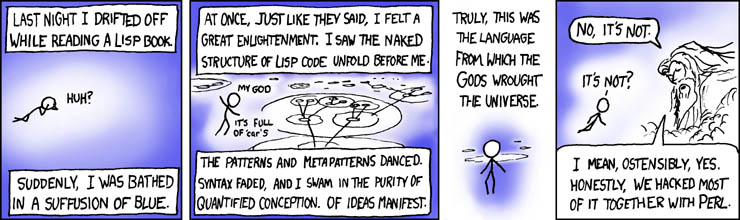
Another from xkcd, this one titled Lisp.