July 25, 2008

Friday Fun: Nancy Kress rocks!

Nancy Kress has long been one of my favourite sf authors and her new book Dogs looks pretty cool.

Here she is talking about it on John Scalzi's Whatever blog:

In 1998, four years after it first came out, I read Richard Preston’s non-fiction bestseller, The Hot Zone, which harrowingly details the importation of monkeys infected with Ebola into the United States. The monkeys were housed in an animal holding facility in Reston, Virginia, destined for research by pharmaceutical companies, when they began to die with the characteristic, horrifying “bleeding out” of Ebola. Both the CDC and USAMRIID, the United States Army Medical Research Institute for Infectious Diseases, were called in to deal with the crisis. All the monkeys were destroyed.

I was riveted. Genetic engineering had already begun to take firm hold of my writing, both as potential benefit and as potentially monstrous bioweapon. But now I expanded that interest to naturally occurring pathogens that could be just as deadly. What if Ebola in its most dangerous form had been transmitted to monkey-house workers? What if it had gotten out into the general population?


Another interview with her on the Feminist SF blog.

July 18, 2008

Friday Fun: World of World of Warcraft

The Onion again: 'Warcraft' Sequel Lets Gamers Play A Character Playing 'Warcraft'

It's a mock news video report on people who play a game where they play WoW within the game itself.

What BoingBoing has to say: "The Onion nails the future of videogaming in this clip on World of World of Warcraft, a new videogame that allows you to play at being someone playing World of Warcraft."

One again, a bit too close for comfort.

July 11, 2008

Summer blogging break

Well, it's that time again. I'll see you all back here around the second or third week in August.

One thing that will be a bit different about the blogging break this year is that I've scheduled some Friday Fun posts for while I'm away. It's just recently that Blogger has allowed us to write posts and schedule them for later publication, something most other platforms have had for a while.

Blogging breaks are for reading books, of course. So, here's some of the books I'm planning to read over the next little while. It's a nice mix of novels (mostly horror this year, for some reason) and popular science. The popular science, at least, I'll end up reviewing here. Those reviews will probably be the first few posts when I return.

  • The Sum of All Fears by Tom Clancy
  • Bad Moon Rising by Jonathan Maberry
  • The Ruins by Scott Smith
  • Heart-Shaped Box by Joe Hill
  • Pursuit of Genius: Flexner, Einstein, and the Early Faculty at the Institute for Advanced Study by Steve Batterson
  • The Wraparound Universe by Jean-Pierre Luminet
  • Archimedes to Hawking: Laws of Science and the Great Minds Behind Them by Clifford Pickover

Have a happy, safe and relaxing summer.

Friday Fun: Sea Monsters!

Darren Naish over at Tetrapod Zoology is having a Sea Monsters week on his blog. The series is mostly investigating various legends and hoaxes and is quite a lot of fun:

July 10, 2008

Solove, Daniel J. The future of reputation: Gossip, rumor, and privacy on the internet. New Haven: Yale University Press, 2008. 246pp.

Another cautionary book about the effect of the Internet on our lives, this one concentrating on the effect that it can have on our privacy.

Overall, I liked the book for its detailed exploration of the effects, mostly potentially negative, of blogs and other social tools can have on our lives, how we can regret things we expose about ourselves and the things other people can expose and reveal about us. How little incidents can burst into Internet controversies and our 15 minutes can be excruciating. On the other hand, there were some vaguely Chicken Littleish aspects of the book as I feel some aspects were oversold. The book also has a academic and legalistic tone at times, drifting away from the more popular tone it maintains most of the time. Some of the extensive legal information in some of the chapters was probably not necessary. That and the occasional repetitiveness gave the impression that the book was a little padded -- that it could have been an absolutely fabulous 20 page essay in The New Yorker but not so much a 246 page book. The highly legalistic middle chapters almost lost me.

So, what's the book about?

At the beginning we learn about the Dog Poop Girl and the Star Wars kid and all the others who've been exposed to extreme humiliation on the Net against their wishes. It's an interesting discussion about the control we should have over our reputations online: do minor transgressions deserve the over the top exposure to ridicule, does some harmless fun deserve any? Should we be able to have any control if a jilted girlfriend blogs about us on a very public blog. Should gossip and slander fall under freedom of speech?

When we trespass societal norms, society gets us back into line by shaming us into behaving. That's fine in a village, but shaming someone on the Net is beyond global. And should minors be treated differently than adults? And if so, how to enforce it. Shaming on the Net can be all out of proportion to the crime.

Once upon a time, if someone violated our privacy or insulted us, we challenged them to a duel! What legal recourse do we have in the online world? And should we have legal recourse or should it just be the wild west? How do you balance free speech with anonymity and accountability?

In the end, we have to find a balance between freedom and privacy, anonymity and accountability. But how? This book certainly places a lot of trust in various legal systems to solve our problems for us, but I'm not so sure. It really is the wild west out here on the Internet and there's no sheriff in sight.

This is a brave book in many ways, to try and throw a rope around the nebulous and unstructured web but perhaps a bit naive as well. Worth reading, for sure as it will make you think and think deeply about some very important issues. Probably there should be the short version, something that we can all get our kids to read before they expose themselves too widely on the Web.

Any library collection that covers Internet culture would benefit from this book. In an academic context it fits is any of law, science, business or social science collections. Even high schools and public libraries should consider this book as the ideas are certainly relevant and vital for young people.

July 9, 2008

Interview with Eugene Wallingford of Knowing and Doing

Welcome to the latest installment in my occasional series of interviews with people in the scitech world. This time around the subject is Eugene Wallingford, Head of the Computer Science Department at University of Northern Iowa and author of the blog Knowing and Doing. I've been following Knowing and Doing for most of the four years it's been running (Happy Blogiversary, Eugene!) and I've always been impressed by Eugene's insights into the world of computer science, especially from the educational viewpoint. Since it's been quite a while since I interviewed a CS faculty member, I thought it would be a perfect opportunity to see what Eugene thinks about some of the important issues in the field today. I think there's some food for thought in the interview for librarians supporting CS programs and students.

Thanks to Eugene for his thoughtful responses. Enjoy!


Q0. Hi, Eugene, please tell us about yourself, your career path and how you got to be the Head of the Computer Science Department at University of Northern Iowa.

Thanks, John, for asking me for an interview. I am honored to share a few thoughts with your readers.

From the time I was seven or eight, I wanted to be an architect. All of my career planning in school aimed that direction. Academically, I liked everything and so had a full load of math, science, literature, history, and social science.

I started college as an architecture major. While I liked it just fine, something was missing. Somehow, I was drawn toward computer science. I ended up double majoring in CS and accounting, but CS was my passion, especially artificial intelligence. I went on to grad school, specializing in knowledge-based systems. My dissertation focused on the interaction between memory and domain knowledge.

A little over three years ago, we were nearing the end of an interim department head's term. I'd never given much thought to being an administrator, but I saw many ways in which we could improve and thought for a moment that I might be the right person to help us get there. I am now ending my first 3-year term and have agreed to continue on for three more years. Looking back, I see some improvements but, frankly, had hoped to have accomplished more. This is a tough job. It lets me be a computer scientist in some ways but takes time away from doing all of the CS I love. I'm committed to helping us move forward for another term, and then we'll see.


Q1. Do you have a theory of blogging? What got you started blogging and what do you get out of it and what keeps you going? I'm sure all your faithful readers are hoping you can add comments to your blog at some point.

I don't think I have a theory of blogging. I first started because I had things I wanted to say. Every computer I had ever owned was littered with little essays, reviews, and conference notes that no one had ever seen. I'd been reading several blogs for several years and thought that starting a blog was a way to make some of my writing more permanent. If others found it worth reading, all the better.

My blog consists mostly of short pieces connected to my professional life as a computer scientist and faculty member. I make connections among things I read, write, see, and do. My one personal indulgence in writing is running, and I've written quite a bit about my experiences training for marathons. Some of my more interesting pieces in this category have made connections from training and running to software development.

Occasionally, I write something that is purely personal, or something that made me smile and laugh. I don't think anyone really wants to hear about what I eat for meals or who I am voting for in elections, so my blog has never veered in that direction. But readers get to know me as a professional person, and I do think that knowing something about the person on the fringes adds depth to how they read my other pieces.

Comments... Yes, I understand. When I first started blogging -- four years ago today (July 9)! -- I planned to add comments. The tool I use to blog is very simple and didn't make that easy. I've just never gotten around to it.

I read many blogs in which comments make a valuable contribution to the message. In others, they add little. There are many ways in which I would relish an ongoing conversation with readers. Adding comments is still on my wish list.


Q2. You blog a lot about teaching computer science. Do you have a teaching philosophy? How do you think teaching computer science differs from teaching other disciplines?

There was a thread recently on the SIGCSE mailing list about teaching philosophies. Many schools ask job applicants for a statement of teaching philosophy, and some folks think that's silly. How could new Ph.D.s have teaching philosophies when they have spent little or no time in a classroom?

I've been on the CS faculty for sixteen years now, and I can't say that I have a coherent, pat teaching philosophy even now. Were I to apply for a new job, I would have to do what those new Ph.D.s have to do: scour my mind for bits of truth that reflect how I teach and how I think about learning, and then mold them into an essay that captures something coherent about me on this day.

My blog exposes some of these bits of truth as I write about my experiences in the classroom. It will be a wonderful resource the next time I have to write a statement of philosophy.

Thinking back to all I've written in the last few years, I can see some themes. Learning is more important than teaching. Students learn when they do. Students learn when they want to do. What I can do as a teacher is to create an environment where students come into contact with cool and powerful ideas. I can organize ideas, skills, and tools so that students encounter them in a way that might spur their desire. Ask students to write programs and solve problems. Ask them to think about how and why. Ask them to go deep in an area so that they learn its richness and not its surface chemistry. Oh, and show as often as I can and in as many ways as I can how much I love computer science. Show what I learn.

That paragraph would get me started on a philosophy statement.

Computer science is an interesting mix of mathematics and programs. Most people don't realize that it is a creative discipline -- a discipline in which making things is paramount. In that sense, we can learn a lot from how writers and artists (and architects!) learn their craft.


Q3. Another of your favourite themes is how computing is infiltrating all the other sciences -- in other words we're getting to the point where it's computational everything. What got you interested in that trend and where do you see it going?

This is not as new as it might seem. Computer science has always been about applications: creating solutions to real problems in the world. The discipline goes through spurts in which it looks inward, but the focus always turns back out. When I was in college in the first half of the 1980s, there was a lot of talk about end-user programming, and even then that wasn't new. Alan Kay has been talking for forty years about computing as a new medium for expressing ideas, a medium for every person. Before that, pioneers such as Marvin Minsky said similar things.

What's happening now is a confluence of several developments. Computing power has continued to grow at a remarkable pace. Our ability to gather and store data has, too. We realize that there will probably never be enough "computer scientists" to solve all of these problems ourselves, and how could we anyway? Biologists know more biology than I ever will; likewise for economics and astronomy and geography and most other disciplines. We are reaching a point where the time is right to fulfill the vision of computing as medium for expressing and testing ideas, and that will require we help everyone use the medium effectively.


Q4. Enrollment has been an issue in the CS community for a while now. Are you happy with the current levels of enrollment? What do you think are some of the ways to get enough students of all kinds interested in CS and willing to consider it as a major? How can we improve the diversity of the students willing to give CS a shot?

We've started to see a small bounce in our enrollments, and I think this trend will continue for a while. I'm not sure that we will ever see the large growth we saw in the 1980s and 1990s, but that's okay -- as long as we recognize our need to broaden the base of people who can use computing in their own disciplines.

Figuring out how to get more students to major in CS or to learn how to use computing in their own disciplines is not easy. If I knew the answer, my school would have a lot more majors and students! There are a lot of things we can do: tell our story better; help more people to understand what computing is and what we do; introduce our ideas to more students earlier in school. One thing a lot of us have noticed over the years is that most people learn about CS as something "hard", a discipline that requires special wiring in the brain. While it's probably true that not everyone is suited to do academic research in CS, I think that everyone can learn to use computing as a medium for expressing ideas. If we can find good ways to introduce computing in that way across the population, the number of majors and the number of interested non-majors will take care of themselves.


Q5. Could you tell us a little about your research interests?

As I mentioned in my history earlier, I started in the area of artificial intelligence, a field in which computer scientists work with many others in an effort to make computers do ever more impressive tasks. Most of my work was in Knowledge-based systems, a sub-area that focused on how systems with deep knowledge of a class of problems can organize, access, and use the knowledge to solve those problems. In the mid-1990s, I began to move in the direction of intelligent tutoring systems, which are programs that help people to learn. This was probably a natural evolution for me, given my interest in how my students and I learn new areas of expertise.

In the late 1990s, I found myself drifting toward work in the area of software design and development, which led me more toward programming languages. Notions of design and language were central to my interest in AI, but I found the concreteness of supporting software developers attractive.

As a department head, I don't have much time for research. When I do have time, I work on how to provide support to programmers as they write, modify, and manipulate code. Of particular interest is how to support refactoring (changes to programs that preserve their intended behavior but modify their structure) in dynamic languages, which do not provide all of the cues we need to ensure that a modification preserves behavior.


Q6. Being a librarian, you know I have to ask what journals, conferences, etc., you find most helpful. I'm also curious about any search engines you might use, be they commercial ones like INSPEC, Web of Science, Scopus or "free" ones like CiteSeer, Google, or Google Scholar? Or anything I haven't even mentioned.

Google. That's the answer for so many things! It's my primary tool for search to find new articles. It links me to more focused technical tools like CiteSeer and the ACM Digital Library, as needed. But so many articles are now available directly on the web from their authors that the journals themselves become more like convenient packaging devices than essential units themselves. It's akin to the change in the music industry from the album to the single. Singles fell out of favor for a while, but the advent of iTunes and other music services have really changed how most people come into contact with their music today.

I don't read many journals cover to cover anymore. I do subscribe to the Communications of the ACM and am looking forward to its new format. I also follow the bulletins of several ACM special interest groups (programming languages, AI, and education).


Q7. Again, being a librarian, I'm also curious about any CS-related books you've read that you've found useful or inspiring, either recently or in your formative years.

A few years back, before I had a blog, I created a webpage for sharing books with colleagues and students:

http://www.cs.uni.edu/~wallingf/miscellaneous/recommended-reading.html


I haven't added to that list lately, but it lists most of the CS books I'd recommend yet today, including Abelson and Sussman's The Structure and Interpretation of Computer Programs, Peter Norvig's Paradigms of Artificial Intelligence Programming, and the Gang of Four's Design Patterns. It also lists books that are not technically about CS but which might change how someone thinks about computing and software, such as Stewart Brand's How Buildings Learn -- a marvelous book!

One glaring omission from this page are the works of Christopher Alexander, the inspiration for the idea of software patterns. Most everyone recommends The Timeless Way of Buiding and A Pattern Language, and I concur. But I also strongly recommend The Oregon Experiment, which describes Alexander's experience implementing his ideas on a college campus. This is a thin little volume that I found rewarding.

Most of my CS-specific reading lately has been on Ruby.


Q8. I find it interesting that computer science students still seem to be relatively high users of print books and I was wondering about your take on that phenomenon. Is it still the same or is it changing?

Philip Greenspun has described CS as pre-paradigmatic in Thomas Kuhn's sense, which means that books play an important role in how new ideas are shared and disseminated. Computing has always been rich in print books, from timeless works down to skills books with a shelf life limited by the rapid change in technology. I know many publishers are thinking about ways the market might shift into electronic versions, and more and more books are available on-line now, sometimes in their first run.

A lot of my students are reading books on-line more now than in print. A recent favorite is Why's (Poignant) Guide to Ruby, available at http://poignantguide.net/ruby/. To my knowledge, this book is available only on the web and not in print. I'm curious to see how this trend develops. My guess is that individual authors will create most of the ideas that change how we read their works, which will cascade down to how we publish.

This comes back in to some ways to blogs, which seems like a good way to close the circle on this interview. One thing I love about my blog in comparison to the essays and comments I used to write in regular text files is the ability to link directly to other works. When I drop a short piece onto my blog, it often takes its place within a web of related writings and software pages. The connections among these works adds value to what I write by giving my readers a way to find and explore related work. That is so much more convenient than a list of references at the end, even if it is also a whole lot messier.

Thanks again for asking me to contribute to your interview series.

July 8, 2008

London Science Blogging Conference

As my annual summer blogging break approaches at the end of this week, I'm not sure if I have very many substantial posts left in me. That being said, I would like to point everyone to what promises to be a great event at the end of August in London, England: the London Science Blogging Conference!

It's at the Royal Institution of Great Britain, London, August 30, 2008.

This one is being organized by the Nature Network folks and seems to have a really great program, including both traditional and unconference elements. Here's a link to the associated forums where a lot of discussion is going on about the conference.

Sadly, I won't be there this time around as the end of August tends to be busy in the library world. I'll also be at the Science in the 12st Century Conference at the Perimeter Institute shortly after that, so two conferences so close together at the beginning of the school year certainly is not in the cards. In any case, I look forward to reading blog posts and seeing flickr photos of the event.

July 7, 2008

Fame is fleeting

Faithful readers may recall that I was named the Blogger Blog of Note on June 9th. Well, there was quite a spike in hits for the two weeks that I was featured in the various places that Blogger showcases the Blog of Note.

However, Internet fame is fleeting and things are now more-or-less back to normal. Here's an excerpt from my Xtreme Tracking page from today:

July 4, 2008

Nature vs. PLoS

So, it seems that Declan Butler of Nature has taken a potshot at the business model and publishing practices of the Open Access publisher Public Library of Science.

Now, I'm not going to comment on the truth and accuracy of Butler's claims about PLoS in particular or OA in general. Not surprisingly, Bora does a great job of summarizing that. Of course, I am a staunch OA supporter but I also recognize that there's a wide variety of publisher business models that are valid and that we have to deal with. As most science librarians, I am somewhat critical of Nature's tendency to charge boatloads of money for their journals and journal backfiles, but I do accept that what they do costs money and that they have a right to run their company as they see fit. I don't have a problem paying for stuff that has real value.

However, I do have to say I am very disappointed with this turn of events. Notwithstanding their journal business, I have always been very impressed by the web group at Nature and the fine work they have done on products like Scintilla, PostGenomic, Precedings, Connotea, Nature Network and others. Those are, for the most part, fine products that are really pushing the edges and trying new and exciting things. They are of of the few commercial publishers that really seems to get doing science on the web and I've been happy to promote those products and services in my community here and to present about them to a wider audience. Of course, OA is a very important piece of the puzzle of doing science on the web and PLoS is also trying new and exciting things and really seems to get it. There's a real conflict there. Perhaps Nature's left hand should be telling it's right hand what's really going on out here.

On a side note, related to the previous post on science blogging communities, there's a bit of an exchange in the comments between Hank of ScientificBlogging and GrrlScientist of Scienceblogs, mostly around who owns what and "political litmus tests" for science bloggers. It's worth noting that as far as I can tell, no one on Nature Network Blogs has blogged or commented on the Nature vs. PLoS controversy. Make of that what you will.

Update 2008.07.08: Two very reasonable and sensible posts providing a bit of clarification from the Nature point of view by Timo Hannay and John Wilbanks. Both the posts also have a lot of interesting conversation in the comments.

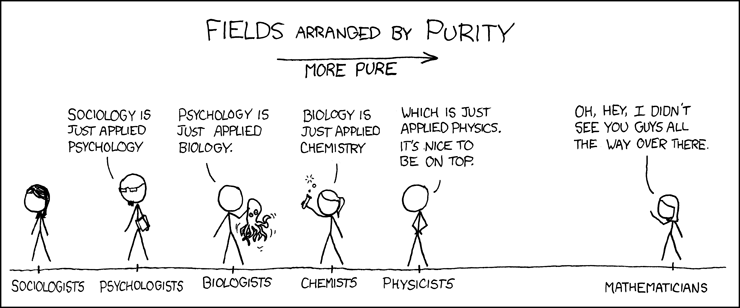
Friday Fun: My discipline is more pure than yours, so there!

As usual, XKCD is right on target!

July 3, 2008

Journal of Science Communication

Thanks to A Blog Around the Clock for pointing me to the latest issue of the Journal of Science Communication, volume 7, issue 2.

This is a journal that I wasn't really aware of but I think I'll be paying a lot more attention to it from now on. The back issues are also a treasure trove of interesting stuff.

Here's some of the current issue's TOC:

July 1, 2008

Science blogging communities

It seems that Carl Zimmer has moved his blog The Loom over to the Discover Magazine site. Phil Plait has also moved Bad Astronomy there too. Quite a couple of coups for this new blog hosting service, a welcome competitor to the ScienceBlogs site. The more the merrier, I say. Each site can only add to the richness and diversity of the science blogging community, making the whole pie bigger for everyone rather than fighting over a fixed audience.

From what I can tell, the Discover site is similar to ScienceBlogs in that they're concentrating on hosting established blogs or inviting specific people to give it a shot. It's still pretty small but I imagine it will grow over time. I wish them luck in their new endeavour.

All of which makes me wonder what all the different blogging communities are out there? Of course, whenever I wonder something, Bora goes and does it. Some of the sites are by invitation only while some allow anyone to set up a blog and some are somewhere in between. Here's the list Bora came up with:


And that's not counting magazines, newspapers and other media outlets that have science blogs like Wired (and Correlations with PBS), Time, the CBC or the NYT and others I'm sure.

June 29, 2008

One Big Library Unconference: Thoughts from Friday

Well, it's over. And I think it went very well.

The One Big Library Unconference was this past Friday at the Centre for Social Innovation here in Toronto. We had about 70 attendees who showed up for the event, which ended up being just about perfect. Fewer may not have given us the critical mass for discussions and many more just wouldn't have worked given the size of the venue.

The day of the unconference went very smoothly, without any significant issues or problems. The only problem we had was that the AC for the CSI was a little flaky so some of the sessions were a little too warm. Over all, people arrived and checked-in, had some coffee and muffins, we welcomed them and they voted for the sessions for the rest of the day. We decided on the spot to let Trevor Owens of Zotero take the opening spot while we set the program for the rest of the day.

The program items for the rest of the day are a bit of a blur at this point, but they all seemed to go quite well, with lots of good discussion. We ended up with two tracks, one a bit more on the technology demo side and the other to more open discussion. Hopefully more session summaries will start appearing on the web and we'll be able to read about them. I would like to thank the students and recent grads I hijacked into moderating the Educating for the One Big Library session for being great moderators and such good sports.

Check out the On the Web page on the wiki. There's already a few items out there as well as links to pics on Flickr and tweeting on Twitter.

Will there be another one? There's certainly a feeling of momentum among we organizers and we're certainly grateful for the many kind words of encouragement during and after the unconference, but it's just too early to tell if we'll do this again and, if we do, what form it might take.

I would also like to take this opportunity to salute the efforts of my colleagues, partners in crime and fellow organizers Stacy Allison-Cassin and Bill Denton as well as thanking our grad student assistant Mandy Frake for all her hard work and support. (Yay us!) Further thanks go to our UL at York, Cynthia Archer, for sponsoring the day. She trusted us right away with pulling off this rather strange idea for an event. Further thanks to Yvonne Bambrick and the staff at the CSI and Big Poppa Barista for coffee.

Most of all, of course, for any unconference it's the participation and interest of all the attendees that make the event a success. Thanks to everyone who was there, who suggested a topic, moderated or presented and who contributed to the discussions.

(Don't forget, if you've created any online content related to the unconference please tag is with "onebiglibrary" and let us know about it on our wiki On the Web page.

Also, feel free to let us know about any feedback. You can leave a comment here or email us at onebig at yorku dot ca.)

June 26, 2008

My theory of conferences

I saw this on the Regenerations blog a few days ago:

I have just returned from beautiful Fredericton, where I was a delegate at the 2008 Conference of the Association of Canadian Archivists. This year's theme was "Stemming the Tide: Archives and the Digital World" and although the sessions did focus primarily on electronic records, digital archives initiatives and the implementation of electronic records management systems, there was a lot of information that could be applied to the library world. Many libraries and archives exist in assorted partnerships, such as Library and Archives Canada, and it is a given that these so-called sister professions have a lot to offer each other.

Of course, a line (usually financial) must be drawn somewhere, and it would be impossible for anyone to attend all the conferences that look appealing. What I am wondering is this. Do you ever attend conferences that are not strictly related to libraries? I can think of librarians who have attended leadership events, and IT conferences, but are there others that you would attend that have particular bearing on your jobs? Does plain ol' interest ever win out in your choice of conferences, rather than attending only those that you "should"?

And I thought it might be worthwhile to briefly explain my own theory of conference attendance.

First of all, there seem to be two overall frameworks for conference attendance out there: go to the same one every year or go to a different one every year. The first leads to integrating into a strong community and more solid networking. The later leads to broader networking and more diversity of ideas that you are exposed to.

I started my career more towards going to the same conference every year, mostly attending the Special Libraries Association (SLA) conference with one or two others interspersed due to travel issues. Lately, however, I've tended to want to go to a different "out of town" conference every year to expand my horizons.

So, over all:

  • Local Library Conference. It's really important to try and regularly attend the local, general conference. For me that's the Ontario Library Association Conference. That leads to building a good local network as well as getting exposure to ideas and innovations from across the library spectrum. I'm lucky that the OLA conference is very large and so affords lots of opportunities to both attend sessions and to present your own ideas. I've presented there several times in the past and will be presenting there in 2009 (on Science 2.0, natch).

  • Diversify your library conference experience. Like I said, I used to go to SLA all the time. Not so much anymore. As my work life has moved more towards supporting Engineering programs, the American Society for Engineering Education (ASEE) is becoming more relevant for me, that that's the conference I'll probably be attended more often than not in coming years. But it's not like I'll never attend another SLA. As well, I'm really interested in library computing issues so I'm sure I'll attend another Computers in Libraries one of these days. I've also really wanted to attend the ASIS&T conference for a more theoretical take on issues. Another conference I've been long interested in attending is the ACM/IEEE Joint Conference on Digital Libraries. So, you can see that my interests are far-reaching and wide-ranging as well as very specific. Getting exposure to all these communities is a good thing.

  • Domain-specific conferences. I'm a science & engineering librarian. So, it's going to be very important to me to keep up with the scientists and engineers -- the state of their pedagogy, how they're communicating with each other, what the main trends are in their various fields, what they're thinking about the future of science. In that case, I also want to try and attend conferences where most of the attendees are scientists and engineers. For me to become part of their communities and to network with them is a huge opportunity, to both learn about them and, hopefully, to educate them a little about my world and what we can do for them.

    In the past little while, SciBarCamp and the North Carolina Science Blogging Conference are examples of conferences I've attended to get that perspective. It's certainly there at the ASEE conference as well, what with over 3000 engineering educators present. Coming up, I'll be attending the Perimeter Institute's Science in the 21st Century conference as well as the successor conference to the NCSBC, Science Online. FSOSS is coming up too. Like I said, these conferences are incredibly important for me. They're both fun and very instructive. After all, we support the education and training of scientists and engineers so their concerns are our concerns, their future is our future.

    Most academic librarians likely find themselves belonging to multiple communities, like I find myself belonging to the library and scitech communities, and it's important to be part of and knowledgeable about those communities. I know several who are attending the ELPUB conference this week which is another great opportunity to stretch out beyond the library world.

Of course, one size doesn't fit all and your mileage may vary. Funding and time are limited, so I take advantage of local conferences of all types as much as I can.

What's your theory of conferences?

June 22, 2008

Off to Pittsburgh

A bit later this afternoon I'll be hopping on a flight to Pittsburgh for the 2008 ASEE Annual Conference. I haven't been to an ASEE Annual Conference in a number of years so I'm really looking forward to this one. I've also never been to Pittsburgh so I'm looking forward to that too.

Since the program and social calendar at the conference are quite full and I'm coming back Wednesday evening, I'm not sure if I'll be blogging too much while I'm there. I'll try and post some short sessions summaries when I get back. As well, Friday is the One Big Library Unconference, so I'll have to hit the ground running for that.

If you're at ASEE and you see me in the hallways or in one of the sessions, please stop me and say "Hi!" As surprising as it constantly is to me that people actually read this blog, I do enjoy getting to meet all of you out there face to face.

Carr, Nicholas. The big switch: Rewiring the world, from Edison to Google. New York: Norton, 2008. 276pp.

This is a book with a profoundly split personality. It's like two books warring in the bosom of one volume. It's a bit hopeful and visionary but it's also cranky and complaining.

And it's not like the author Nicholas Carr is any stranger to controversy. He's famous for stirring up a hornets nest in the business IT community with the article IT Doesn't Matter in the May 2003 Harvard Business Review, followed up by the book Does IT Matter? Information Technology and the Corrosion of Competitive Advantage. More recently, he's quite infamous for the Atlantic Monthly article Is Google Making Us Stupid?

So, he's a guy that doesn't pull any punches.

So, what's The Big Switch all about? Ostensibly, it a book that compares the rise of utility computing with the development of the delivery of electric power to the USA as a mass utility. In other words, during the late 19th century, electricity went from something that mostly industrial plants provided for themselves in dedicated generators to something that a centralized utility provided for everyone, for a price. And so computing power has evolved as well. Once upon a time, computing power was chained to a single organization via a mainframe computer or to a single desktop via a PC. Carr's book describes the incredible recent developments where so many companies are now outsourcing their IT and raw computing needs to utility-like providers with vast server farms. Cloud computing, it's often called. Computing power and processes are commoditized the same way electricity was a century or more earlier. Amazon Web Services, a lot of what Google does with products like Docs. This was a very interesting part of the book. I knew a bit about utility computing but not that much and I certainly didn't know a lot about the electrification of the continent.

That's the first half of the book.

The second half is a darker look at the world of Web 2.0. Carr takes a very hard look a the wide-eyed optimism so prevalent among web-heads. What about the job losses and dislocations coming from new business models and paradigm shifts? The fallout from the shift in marketing and media production for news and cultural products. The balkanization and narrowing of taste due to ultra-narrowcasting media and the amplification of negativity and trolling. The potential for terrorists and others to use the web for attacks and violence. The tension between privacy and control on the net, particularly the corporatization of virtually every last web space and censorship and control by totalitarian governments. Carr makes a lot of very good cautionary points in this part of the book. However, I didn't find all of it very convincing. As well, in a lot of cases, he's really complaining about something where the horse has already left the barn. There's no going back. It's certainly an interesting counterpart to Shirky's Here Comes Everybody or to Wikinomics, and would make an interesting book to read with those as part of a Web culture course.

Overall, this is a book I would recommend quite highly. The first part has a lot of interesting information and history that leads into some interesting ideas about the future of computing power as a utility. The second part, covering the dark side of the Web 2.0/Web revolution is less convincing but still makes many compelling cases that cannot be easily or lightly dismissed.

June 20, 2008

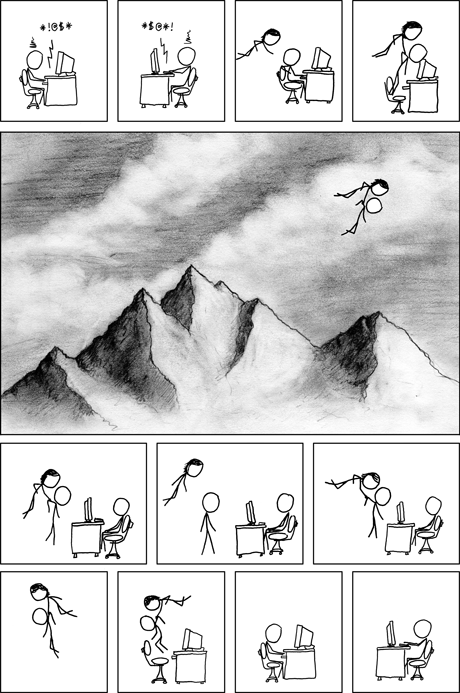
It's easier to be a jerk to words than to people

Truer words were never spoken, or at least almost the same words (mouse over the image in the comic on the XKCD site).

A nice thought from XKCD for a Friday morning:


Friday Fun: Area Eccentric Reads Entire Book

The Onion is always very funny, if sometimes cutting a little too close for comfort:

GREENWOOD, IN—Sitting in a quiet downtown diner, local hospital administrator Philip Meyer looks as normal and well-adjusted as can be. Yet, there's more to this 27-year-old than first meets the eye: Meyer has recently finished reading a book.

Yes, the whole thing.

"It was great," said the peculiar Indiana native, who, despite owning a television set and having an active social life, read every single page of To Kill a Mockingbird by Harper Lee. "Especially the way things came together for Scout in the end. Very good."

*snip*

According to behavioral psychologist Dr. Elizabeth Schulz, Meyer's reading of entire books is abnormal and may be indicative of a more serious obsession with reading.

"Instead of just zoning out during a bus ride or spending hour after hour watching YouTube videos at night, Mr. Meyer, unlike most healthy males, looks to books for gratification," Schulz said. "Really, it's a classic case of deviant behavior."

June 18, 2008

IEEE Annals of the History of Computing

Lots of interesting stuff from v30i2:

June 17, 2008

JCDL/DL: International Conference on Digital Libraries

This is a conference I have to get to one of these days. This year's edition is actually going on right now in Pittsburgh -- ironically, since I'll be in Pittsburgh next week for ASEE. Had I been sufficiently foresightful, it would have made a great two week visit!

You can see the program on the Conference web site here.

The ACM also has the proceedings online already! Here's some very brief excerpts from the TOC: