February 15, 2007

Science Librarian -- York University Libraries

This is a posting for a new tenure stream librarian at my library, the Steacie Science & Engineering Library. If anyone has any questions, please feel free to contact me via email at jdupuis at yorku dot ca. I'm not on the search committee, but it is at the library I work at every day so I can answer both fairly specific questions about Steacie as well as general questions about working at York. Like I said, this is a brand new position and a terrific opportunity to work at a great institution. The ad is online here as some other library postings at York here.

Science Librarian

York University Libraries seek a self-directed and public service-oriented Science Librarian based in the Steacie Science & Engineering Library.

The Science Librarian will be responsible for faculty liaison, collection development and the delivery of library programs for assigned disciplines and will participate in research consultations and outreach activities to departments and research centres. Responsibilities include selection of information resources, collection management and evaluation in such fields as kinesiology, neuroscience and mathematics. He/she will work individually and as part of a team to develop and provide reference services and information literacy programs to York’s community of users taking full advantage of the online learning and web environments. She/he will also participate in project and committee work for York University Libraries and the University. Some evening and weekend work is required.

York University offers a world-class, modern, interdisciplinary academic experience in Toronto, Canada’s most multicultural city. York is at the centre of innovation, with a thriving community of almost 60,000 students, faculty and staff, who challenge the ordinary and deliver the unexpected.

Steacie Science and Engineering Library is one of four libraries within York University Libraries. The Steacie Science and Engineering Library attracts a half million visitors a year and provides specialized resources, and reference and instructional services to the science, engineering, and health programs of York University. Three full-time librarians and seven full-time support staff are currently based in the Steacie Library.

Qualifications: An ALA-accredited MLIS or equivalent with up to two years’ post-MLIS experience. Educational background relating to science, technology, health, or kinesiology. Knowledge of science and technology literature and reference resources, and awareness of emerging trends in scholarly communication. Experience with Web authoring software and Web support technologies; familiarity with Web 2.0 technologies preferred. Strong client-centred service philosophy and evidence of professional initiative and leadership. Ability to handle multiple responsibilities and projects concurrently. Strong written and oral communication skills, including demonstrated skills in teaching and public communications. Ability to work effectively and collegially with a diversity of colleagues and clients. Interest in research, professional development, and university committee work.

The Science Librarian position is a tenure-track appointment to be filled at the Assistant Librarian level and is appropriate for a librarian with up to two years’ post-MLIS experience. Librarians at York University have academic status and are members of the York University Faculty Association bargaining unit (http://www.yufa.org/). Salary is commensurate with qualifications. The position is available May 1, 2007. All York University positions are subject to budgetary approval.

York University is an Affirmative Action Employer. The Affirmative Action Program can be found on York's website at www.yorku.ca/acadjobs or a copy can be obtained by calling the affirmative action office at 416-736-5713. All qualified candidates are encouraged to apply; however, Canadian citizens and Permanent Residents will be given priority.

Campus resources include an on-site daycare centre and centres relating to gender equity, race and ethnic relations, sexual harassment, human rights, and wellness. York University encourages attitudes of respect and non-discrimination toward persons of all ethnic and religious groups, regardless of gender or sexual orientation.

The deadline for applications is March 12, 2007. Applications, including a cover letter relating applicant qualifications to the requirements of the position, a current curriculum vitae, a link to online examples of work where relevant, and the names of three referees, should be sent to:

Chair, Science Librarian Appointment Committee
York University Libraries, 310 Scott Library
York University, 4700 Keele Street
Toronto, Ontario, Canada, M3J 1P3
Fax: 416-736-5451

Applications should be sent by mail or by fax with a mail copy following. Applications sent by e-mail will not be accepted.

Is computer science science?

Knowing and Doing has a post on Computer Science as Science which has a lot of interesting insights:

Computer science is grounded in a deep sense of empiricism, where the scientific method plays an essential role in the process of doing computer science. It's just that the entities or systems that we study don't always spring from the "natural world" without man's intervention. But they are complex systems that we don't understand thoroughly yet -- systems created by technological processes and by social processes.

*snip*

As Bertrand Russell wrote a century ago, science is about description, not logic or causation or any other naive notion we have about necessity. Scientists describe things. This being the case, computer science is in many ways the ultimate scientific endeavor -- or at least a foundational one -- because computer science is the science of description. In computing we learn how to describe thing and process better, more accurately and more usefully. Some of our findings have been surprising, like the unity of data and program. We've learned that process descriptions whose behavior we can observe will teach us more than static descriptions of the same processes left to the limited interpretative powers of the human mind. The study of how to write descriptions -- programs -- has taught us more about language and expressiveness and complexity than our previous mathematics could ever have taught us. And we've only begun to scratch the surface.

February 13, 2007

New science carnivals

Two newish science carnivals for your attention:


  • Philosophia Naturalis is a monthly carnival that's been going since September 2006. Here's the story:
    Philosophia Naturalis will take the physical sciences and technology as its focus. The physical sciences include physics, astronomy, cosmology, chemistry, mathematics, computer science, and Earth sciences. And just as medicine is applied life science, technology is applied physical science, including such topics as nanotechnology, robotics, artificial intelligence, alternative energy, and quantum computing. We also intend to be generous about considering "borderline" topics for inclusion.

    As they mention, this is really the first carnival to cover the non-life sciences. The most recent is #6 at Science and Reason.

  • The Carnival of Mathematics also is filling a gap in carnival coverage, as there hasn't been one covering math exclusively before. The story:
    Biology bloggers have Tangled Bank. Medical bloggers have Grand Rounds. Neuroscience bloggers have Encephalon. And now math bloggers have the Carnival of Mathematics. If you have anything to blog about that’s related to math, it belongs here. Possible topics include,

    - Proofs of theorems and formulas, whether in pure or applied math;
    - Explanations of mathematical concepts, as basic as those on ScienceBlogs’ basic concepts series;
    - Anything related to math education, from complaints about innumerate students to long-winded theories of how to teach math;
    - Debunking bad math, especially when used to bolster bad science, bad economics, or bad politics;
    - How to apply good math to other fields like physics, economics, computer science, and ;
    - Math in popular culture: the TV series Numb3rs, the movies Pi and Proof, any book by Simon Singh, and so on.

    Despite the mathematical inclination of the carnival, theoretical computer scientists and theoretical physicists are welcome to submit posts about their fields. Both disciplines are highly mathematized, and when it comes to such subfields as Lie theory, logic, and complexity theory, it’s hard to pinpoint where one discipline ends and other begins.

    This one's planned for every two weeks. The first one is up at Abstract Nonsense.

Of course, I would be remiss in having a carnival post without mentioning our own revitalized Carnival of the Inforsciences. The most recent is at Libraryola, the next is scheduled for February 19th at Innovate .

The Joy of Science

Zuska of Thus Spake Zuska has started an informal, online course in the feminist philosophy of science that she's calling Feminist Theory and the Joy of Science or just The Joy of Science for short.

It's based on a real-world course she wanted to run at one point. Here's her course description:

This course explores the existence of pleasure, intellectual excitement, and desire as an important component of theorizing and doing science and engineering. We will examine the presence and/or absence of accounts of pleasure/desire in feminist theories of science, and in mainstream science and engineering texts and pedagogy. We will also examine feminist accounts of what might be termed the diversity challenge in engineering, and how feminist theories of science and pleasure can inform this issue. The implications for an adequate feminist theory of science, and for attracting members of underrepresented groups to science and engineering, will be a focus of the course.

And the syllabus, again based on a real-world course:
  • There are two videos listed on the syllabus to which I don't have access. I won't be discussing them, unless by chance I find I way to get hold of them in time.
  • Since I only have one student (me), I won't be having the group presentations each week. However, I do have readers - that's you! And we do have a comments section. If you've done the readings and the theoretical analysis, you may have some insights you want to share with the world at large. Even if you haven't, you may read my take on the week's readings, and decide you have something to say about that. The comments section will, I hope, function as a sort of class discussion.
  • I won't be assigning final papers - though I may write one myself.
  • The course was designed assuming that mostly non-scientists and non-engineers would be taking it. The final project, taking apart a hand mixer and describing its workings and their experience in taking it apart, was intended to let them encounter a simple, everyday, technological object from a new viewpoint. I wanted students to explore how well the feminist theory they'd been reading about applied - or did not - to their experience. Perhaps at the end I'll ask you, the reader, to talk about your encounters with simple, everyday technology. I'll have to do some more thinking on this one.
  • Oh, and no grades! THAT ought to get me a good rating on RateMyProfessor.com!


It's a very cool idea, running a course for blog readers to follow along with. Of course, like any course there's a reading list, some introductory material, as well as lectures and discussion for week one.

The various posts are all linked via Zuska's Joy of Science tag, with links to the initial posts at the bottom of the list. There are aleady 11 posts in the series, most of which I've already linked. It seems like it's going to be a very worthwhile exercise to follow along with the course, even if you don't get around to doing the actual readings. I know I probably won't do most of the readings myself, since being on sabbatical means not having quick access to the books in our collections.

February 9, 2007

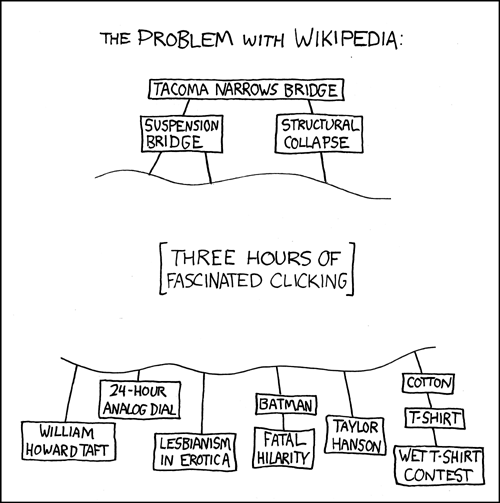
Friday Fun: The Problem with Wikipedia

I love the xkcd web comic and this is one of the funniest I've seen in a while. Doesn't every single Wikipedia search start and end this way? Doesn't Raymond Chandler end up at Matt Helm? Isaac Asimov at Pinky and the Brain?

February 8, 2007

SLACer videos (and a CERN one too)

Via Chris Leonard, a series of three videos produced by Robert Scoble's Scoble Show: A Videoblog about
Geeks, Technology and Developers
featuring his visit to SLAC. There's a total of nearly 2 hours of video. I haven't watched it all yet, but what I have watched is very good.


There's lots of cool looking stuff in the Scoble Show, include a couple of Cooking with Geeks videos.

Also via Chris, a short video from the PhysMathCentral featuring an interview with Jens Vigen, librarian at CERN. He talks quite a bit about open access, preprints, eprints and how that all plays out in the world of particle physics. A great quick introduction to scholarly communication patterns in that branch of physics.

Kim Stanley Robinson interview at LabLit

One of my favourite science fiction authors is Kim Stanley Robinson. His novels are always deep and interesting on many levels -- if not always incredibly compelling plot-wize. Well, his new global warming series of thrillers seems to be a bit of an exception to the plot problems and are getting glowing reviews. The first of the novels is coming up soon on my to-be-read pile.

LabLit just posted a terrific interview with Robinson where he touches on science, politics, science and politics, science fiction, global warming and the intersection of all of the above. A couple of tastes:

How important is the perception of genre – do you ever feel that being labelled as a ‘science fiction’ writer has held you back or restricted your readership?

This is a complicated issue, not easy to characterize. I believe in science fiction as being the genre of novels best able to capture the feel of our times, especially in the developed and industrialized West. So I am comfortable with my basically instinctive choice of what kind of method to take in writing novels.

“Perception of genre” is a different thing however, and it speaks to assumptions and attitudes that are outside of my control and also hard to be really accurate about. I can see that there is a part of our book culture that still looks down on science fiction, and there are readers out there who won’t read it on principle or by habit, but I feel that this attitude is their problem and not mine, and that they are missing out on some of the greatest novels of our time, and also not understanding our culture as well as they could if they did read science fiction. So, there is little I can do about this but to write novels that are relatively transparent to anyone used to reading novels of any kind, focusing on a kind of “realism of the near future,” which means people used to historical or contemporary novels ought to find mine easy to read. And then also to talk about these matters openly, and with the idea of emphasizing always that we in the West, and maybe everywhere now, are already living in a science fiction novel that we are all writing together; that history is now a science fiction story; so that reading science fiction (and I always include “novels about science” (or lab lit) as a particular kind of science fiction) is a way of orienting oneself and examining questions of meaning in the contemporary world, as well as getting a lot of artistic pleasure as a reader.

*snip*

In your novels, what are your favorite strategies to transmit any necessary science without losing or boring the reader?

Well, I will do anything, including the person who needs things explained, which after all can be anyone, for instance an expert in a slightly different field; and I kind of like lectures too. This is an issue in the aesthetics of science fiction, because it became the fashion for a while to disparage exposition as a kind of literary faux pas, with writing workshops calling them “infodumps”. But I feel this can be taken too far, and often results in an end product that says nothing new and has no way of really speaking about science, because of the perceived need for unrelenting action at all times. But life is not like that, so this is not a realism. When I started my Mars books I decided consciously to take the time to write about anything I wanted, including all scientific topics necessary, with the idea that anything is interesting if you make it interesting, and that the surface of Mars was at least as interesting as yet another car chase across same. It resulted in a strange-reading text, compared to much of the science fiction out there at that time, and it scared me quite a bit, but the response to those books encouraged me to think that I had judged correctly, and that readers of novels were open to all kinds of different modes, including exposition.

February 7, 2007

Mamdouh Shoukri chosen as next president of York

I wouldn't normally post on a local announcement like this, but I couldn't resist mentioning that an engineer has been named president of my institution, York University.

Egyptian-born Shoukri, 59, is currently the vice-president (research & international affairs) at McMaster University in Hamilton and a professor of mechanical engineering. A member of the Ontario Research & Innovation Council (ORIC), Shoukri previously worked in various capacities with the Research Division of Ontario Hydro, before becoming a faculty member at McMaster and, later, dean of engineering.

I certainly wish Dr. Shoukri all the best in his new postion (he's starting in July) and I hope to get a chance to meet him and show him around my library.

February 6, 2007

Ontario Library Association Conference, Day 4

Saturday, February 4th, another good day at the conference for me. One hightlight was definately meeting vonjobi (Vernon Totanes) of Filipino Librarian. He's in Toronto doing a PhD at the University of Toronto. It's always a lot of fun meeting bloggers face-to-face after only ever reading their words.

Another hightlight was the Ontario Engineering Librarians meeting. This informal meeting looks like it's going to grow into a more structure for Ontario Engineering librarians to meet regularly and share our experiences. Looks like there's even going to be a blog. I'll post more here as things develope.

The last bit I want to mention is the closing luncheon. The rubber chicken was decent, but I really had to pass on the mushroom sauce (I hate mushrooms) and the salad was about 50% mushrooms too. Just bad luck. At least the carrot cake for dessert was extremely good -- Carrot cake is one of my favourites. The entertainment was Canadian comedian Jessica Holmes of Air Farce fame. She was pretty good, doing some of her signiture impressions like Liza Minelli, Belinda Stronach and Celine Dion.

The only real session that I attended was the Top Tech Trends panel with John Blyberg, Amanda Etches-Johnson and Michael Stephens. This was a good panel with lots of excellent ideas, a great way to condense a lot of trendwatching into a very short period of time. All three panelists took very different takes on the subject, which was interesting.

Amanda Etches-Johnson was up first, and was brave enough to speak without slides; something I wish a lot more of us would do. She identified three main trends we should be watching. First, the growing importance of RSS as a delivery mechanism for all kinds of content. Related to this was the increasing amount of browser integration of RSS amongst the various options. She pointed to the standardization on the little rss icon we all see on blogs and the lower right corner of our browsers. The next trend is a new focus on library websites. She noted that library websites are in trouble and not much real progress has been made on a lot of them since the early days of the web. If we're getting more web traffic than foot traffic in our libraries, then maybe we should think of ourselves as virtual branch managers. We should concentrate of facilitating access to all the great tools that are buried deep in our websites. Finally, Etches-Johnson pointed to the "mindful application of social software" as a trend to watch. By this she meant that we should use social software to be useful in those online social spaces that our patrons inhabit. This involves not having a blog that tries to be everything to everyone, but to target a specific audience and to make sure our social presences have a human rather than institutional feel.

John Blyberg was next. He emphasised the trend towards openness and cooperation: open access, open souce, open spaces, open processes. Libraries are comfortable in our old niche but how to we know we are successful in a new world of collaboration and cooperation. Are we collaborating and cooperating in our own organization. He pointed to Linux as an example of a successful project in the new reality. A world class operating system that was created completely by volunteer effort that has no licensing cost. But, will all this openness lead to something? How about a layer of artificial intelligence on top of all the data on the web, giving us the semantic web where the web can just figure out what we want from what we tell it. We need to check our priorities, open our organizations, initiate content, offer help, cooperate and share.

Last was Michael Stephens. We live in the social web, people live part of their lives online now. Mass collaboration will change everything, people want to talk to each other. Old and new media are converging. The first trend is content: youtube, generate your own Absolut bottle, all these things mean we can generate our own content. Trend: redefine the LIS job, train people to be user experience librarians, web librarians, gaming librarians. Trend: citizen journalism, everyone can be a news reporter or photographer and what does this mean for libraries. Trend: openness and sharing, but remember that open source software is free as in kittens not free as in beer. Trend: participatory culture like tag clouds and library thing, everything is tagable. Trend: experience and play and the new world, like what we can do in Second Life.

There were also quite a few questions, on libraries sharing the content their patrons create; sharing vs. protection; net neutrality; how to trendspot on your own; why there aren`t any open ontologies and what we`re doing now that we can stop doing in order to free up resources to do cool new stuff. One question in particular was kind of telling. A member of the audience suggested that since all aspects of librarianship seem to be permeated with technology these days, to just call this session Top Trends and be done with it. This suggestion prompted some uncomfortable applause. It sounds like a good idea, but seems a bit presumptuous. After all, there are still a lot of areas of librarianship that aren`t dominated by technology issues, like IL, like services for young children and a lot of others too.

Hey there Nerac, Revisited

You may recall from mid-December I mentioned that I was getting a lot of hits from an organization called Nerac. I asked if someone from Nerac might be interested in dropping me an email or making a comment to let me know what had piqued their interest. Well, I didn't hear anything for a while and the whole thing sort of slipped to the back of my mind. A couple of weeks ago I did get an email from Michael Mahoney, Business Development Manager of Nerac, and he graciously agreed to answer a few questions about Nerac and their interest in my post on the future of A&I databases.

Thanks, Mike!

Q. Would you mind describing Nerac a little bit and how it relates to the scitech world? Do you have mostly corporate clients or also academic institutions & research groups?

Nerac, Inc. is an innovative research advisory partner for industry and consumer goods organizations. Our clients turn to us for scientific, technical intellectual property and business decisions. The majority of our clients are corporate, however we do service many university technology transfer departments.

Q. Do you employ and people with library backgrounds as researchers or customer liaisons? How about people with science & engineering backgrounds?

Nerac employs over 100 analysts with a variety of backgrounds in science, technology and business. Many have advanced degrees including several with MLS degrees. We also have patent attorneys and licensed patent agents on staff.

Q. What kind of research tools do you use? Obviously Google, USPTO and other free search engines, but how about Dialog, patent databases, Scopus, Web of Science and other for fee products?

Nerac uses whatever resources it needs to find the information needed to fit the research needs of our clients. The resources listed below are just a few that the staff uses regularly:

A&I and full text patent databases that are load on our in-house proprietary search engine.

Aggregated hosts - STN, Questel, Newsbank and Westlaw.

Value add resources – Knovel, ADIS, Hoover’s and BioPharm Insight.

Free resources – Google Scholar, Google Books, Web search engines, and content found on the invisible web.

Our own direct experiences in research fields.

Telephone networking with experts in the field.

Q. How about journals and other scholarly content -- IEEE, ACM and other scitech publishers? Or mostly on the trade journal side of things?

We do have corporate agreements with a few of the major publishers of Sci-Tech journals for in-house use of their content. If we need papers from the other publishers we order them on behalf of our clients.

Q. Finally, it was my discussion of the future of A&I databases that got this whole thing going. Where do you see that business (and related content businesses like journal publishing) going in the next few years?

Primary content will always be around in some form. There has been some movement toward open access, but it will be interesting to see how that plays out in the market.

Years ago it was enough to send raw premium A&I to a client. The patron could select and read a few papers and hopefully solve their problem. We detected that a shift in secondary content was going to occur a few years ago due to all the free content. We changed our business model to deliver deeper analysis of the problem at hand and offer an opinion on the solution. Both information professionals and information companies need to be aware that you can’t compete with free and stay in business. Ultimately, the value these professionals and companies offer is analysis, advice, and opinion.

That was fun. I certainly wouldn't mind trying out some more interview-style posts here in the future, perhaps with some fellow scitech librarians, bloggers or people in the publishing world.

February 5, 2007

Recently, on ScienceBlogs

A couple of recent posts from ScienceBlogs on the general culture of science (and science in the culture) that I found interesting:


  • Chris Mooney and Alan Sokal have collaborated on a op-ed piece in the LA Times. Sokal being a noted critic of science abuses by the left and Mooney on abuses by the right, they join together to call for a rational way forward, a place for science in the broader culture that's not distorted or denied by political or cultural biases, but based on the scientific method. Needless to say, they're not too impressed with the current state of affairs.
    In truth, there was nothing wrong with inventing science studies; the error was to leap from the valid observation that science arises in a social context to the extreme conclusion that it is nothing more than politics in disguise.

    Such introspection on the academic left has been a heartening sign, and the pronouncements of extreme relativism have subsided significantly in recent years. This frees up defenders of science to combat the enemy on our other flank: an unholy (and uneasy) alliance of economically driven attacks on science (on issues such as global climate change, mercury pollution and what constitutes a good diet) and theologically impelled ones (in areas such as evolution, reproductive health and embryonic stem cell research).

    The potency of this combination has become apparent during the six years of the Bush administration, as many if not most scientific agencies of our government have become embroiled in scandals involving the misrepresentation or suppression of scientific information, gag orders on scientist employees, or other interferences with the processes by which science feeds into decision-making. Tracing these intrusions back to their source, we almost always uncover the same pattern: It concerns an issue in which one of the two principal constituencies of the current administration — religious conservatives or big corporations — has a vested interest.

    *snip*

    At the same time, journalists and citizens must renounce a lazy "on the one hand, on the other hand" approach and start analyzing critically the quality of the evidence. For, in the end, all of us — conservative or liberal, believer or atheist — must share the same real world. Antibiotic-resistant bacteria do not spare deniers of evolution, and global climate change will not spare any of us. As physicist Richard Feynman wrote in connection with the space shuttle Challenger disaster, "nature cannot be fooled."

    To avoid nature's punishment, we must take steps now to restore reality-based government.

    This is a great article, full of terrific ideas that are applicable to more than just the USA; it's already generating quite a lot of discussion on the blogosphere. We should all hold our governments to a reality-based agenda.

  • Janet Stemwedel of Adventures in Ethics and Science has a post about the impact of blogging on academic scientists' tenure decisions.
    While I am of the opinion that many blogging academics are engaged in serious thinking, educating, communicating (to other academics, students, and the broader public), and even mentoring on their blogs -- all of which does contribute to their profession and to society -- how exactly their "work" and "contribution" should be evaluated is unclear. And the reality is, for an activity to "count" for tenure and promotion, it need to be evaluated. At this stage, academic blogs are new enough that few people on tenure and promotion committees would have a clear view of how to judge their quality or "impact". (Indeed, the list of potential axes for judging them helmut suggests seems like it might miss the point of some of what makes blogging useful.) Also, in the absence of general agreement about how blogging might fit into the range of professional activities, it's hard to believe there wouldn't be a good number of folks on the committees judging blogging time as time one could have been using for real professional activities.

    Personally, I think that blogs should definately count as part of a faculty (or librarian's) tenure profile. What I think is important is that it be evaluated in the proper context the person's entire scholarly and professional output. Blog posts won't generally count as peer-reviewed science articles, they won't count as service to the institution, so what's left? Teaching? Are blog posts, even if not directly delivered to students, part of a profs teaching profile? An interesting possibility -- to the extent that the posts in some way explain scientific concepts, comment on the place of science in the broader culture, advocate for a particular political point of view on scientific issues, and probably a lot of other kinds of posts too then yes, I think a scientists blog should probably count in some way as part of their teaching profile. Just not for their own students, but for the rest of the world. I'm sure that there's a million reasons why this will be very difficult to implement, but at least by starting the conversation on where blogging should fit into a academic's long term career profile we might eventually get to a point where blogging finds its proper place.

February 3, 2007

Ontario Library Association Conference, Day 3

Friday, February 2nd, another busy day, with three sessions and one plenary on the agenda. The plenary was by Glen Murray, former mayor of Winnipeg and now well-known as an urban advocate. His plenary was quite interesting, making a very good point that we have to nurture all our cities, big and small, encouraging artistic and research-based activities which bring jobs and increase the quality of life. In turn, if you increase the jobs and quality of life, you actually bring more jobs and investment as the city becomes a good place to live. He particularly stressed the importance of libraries as centres of culture in any community. You have to make your city unique and worthwhile and avoid the could-be-anywhere syndrome of so many North American cities.

The morning session I attended was Windows of Opportunity: Faculty SDI in the 21st Century by Heather Matheson (slides, reading list). This was a fantastic, inspirational session which was criminally poorly attended, probably due to other 2.0ish speakers at the same time, and a slightly misleading title. For me, what this session was really about was not using an open source content management system to create a subject based portal to engage your faculty and grad students, feeding them content and in turn getting them to return the favour and contribute to the system (although it was that too). I was really about taking control of our online lives from our IT departments and bringing it into the control of subject specialists, letting us control what we show our patrons, on our time, at our pace and giving them what we think they need, not what we can squeeze out of one-size-fits-all opacs and websites. Want to integrate RSS, blogging, wikis, RefWorks, reviews and the whole kit in your subject portal? Take charge and get it done yourself. Heather used Joomla as the CMS for her project, which required using some of her own server space and getting her ISP to install it for her. I'm pretty sure plain old WordPress would get you about 60-75% of what Heather has done without the sneakiness or expense. I'm inspired, check out her presentation and you'll be inspired too.

Next up was Information Literacy: Program or Process? A Reality Check by Karen Hunt (not actually present), M.J. D'Elia, Marilyn McDermott and Melanie Boyd. This was quite an interesting session, with a lot of thought-provoking points raised in our group discussion. We split up in to two groups (about 30 each). Each group met with one of the presenters for 15 minutes. Then the groups switched moderators. Each moderator told a quick story about some of their anxieties surrounding their IL performances in the class room and then asked some questions to get our reactions to their stories. At the end, we all discussed our interpretation and reactions to the stories. It was a good session and we all had a chance to probe our own feelings about various parts of our instructional lives. On the other hand, the whole thing bore almost no resemblance to the advertised abstract.

We will explore the pros and cons inherent in attempting to structure information literacy around a program model, and the pros and cons inherent in a more process-oriented approach. It will unearth pressures steering us towards one path over the other.

It wasn't about that at all. The facilitator kept saying the words "program" and "process" but they didn't really have much connection to the stories or any of the discussion that was going on. The session was an interesting idea, but I think the organizers went off track at some point in their preparations and weren't able to get back.

The final session I attended was ILS, The Next Generation: Modularity and Outward Integration by Karen Calhoun. Another outstanding session in what's turning out to be a very enlightening conference. This one focused on what the next generation of Integrated Library Systems are going to look like. They're going to be modular and plug and play, like legos, they're going to decouple the discovery system from inventory control and they definately and are to be standards-based and interoperable. Calhoun talked a little about what users want the most -- to use stuff off campus, to use the library as only one element in their research toolbox, more online resources, seemless linking. Our objectives are integrated access, simplified resource management and to become visible in the user's environment. The tools were going to use to get there include federated searching, reference linking, portals and CMSs.

Next Calhoun talked about federated search and it's weaknesses, including slowness, limits on the number of databases that can be searched, incomplete search results and poor relevance ranking. One option is to just forget federated search and just use Google Scholar, but GS isn't really there yet. She also discussed some of the limitation of reference linking, primarily incomplete or inaccurate metadata. Federated searching and reference linking are fundamentally short term solutions for libraries.

One version of the perfect dream system is a unified library system with a very hierarchical set up with integrated interfaces, metasearch and all the content bound together. This is a difficult dream to realize because all the content to so widely scattered and isolated, many not under the library's control. Another way to look at it is to strive for outward integration, allowing us to use library components in new ways. This vision sees library managed collections found using a wide variety of discovery tools, most not managed by the library in any way. Libraries will concentrate on building the digital special collections that make them unique. Library systems will be interoperable and take advantage of the Amazoogles of the world. External discovery of library based collections.

February 2, 2007

Ontario Library Association Day 2: Me & John Blyberg

The first full day of the conference, day 2 was Thursday and it was a good day overall. Since I was presenting at 10.40, I didn't go to any of the earlier sessions and just decided to relax.

My session, Using Weblogs as a Professional Development Tool, went pretty well, with about 40 people attending. Considering that the time was changed since the original program went out, I'm pretty happy with the turnout. The OpenOffice slides are online here and I've also prepared a pdf version here. This is the first project where I've used an OpenOffice module start to finish and I was very happy with the results. It's just as good as PowerPoint for basic presentation usage.

I also convened John Blyberg's 3.45 session, Not So Confidential: Exposing 2.0 Web Sites. It was a pleasure meeting John and I really enjoyed his session, which was thoughtful and provocative yet full of practical advice and commentary.

It began with a discussion of our love/hate relationship with the opac, with the fundamental questions we ask about our opac: what does it serve and what forms should it take. It's always been the way it is, we don't know where to begin changing it and even if we did, we don't have the resources to really transform it. We have to find a way to use what we already have. So, what are some of the opac's shortcomings? It really hasn't gotten any more effective over time, it's not very customizable or extensible or even very attractive visually. And it can't accomodate user-driven improvements.

And what about our websites? They are also visually unattractive, outdated, static, non-intuitive and basically look like they were made by somebody on their lunch hour in a few weeks. (Ouch! -jd) Now, why should we focus on our web and opac? Because first impressions are important. The opac represents the library to patrons, it's the front line of a lot of patron service and the opac meets people where they are.

How can we make web 2.0 work for us? Hincliffe has a post on "10 ways to take advantage of 2.0" (I'll find it later. -jd). We should encourage social contributions with individual benefit, letting people do something for themselves and the larger community. We should make content editable, encourage unintended uses of content and provide a continuous interactive user experience. We should make sure our site has content feeds, let users establish and build reputations, allow remixing of content -- build small pieces loosly joined. This will allow us to identify our keenest, most active users, people we should engage with to make our systems better. We should also remember not to build systems that deny service to users who are less tech savvy or have older software or hardware.

Some fundamentals. We should have single sign-on, open standards, open source, integrated/seemless opac+website, social software to tag & review opac. We should design for innovation: use APIs, community development, mashups, personal apps, encourage elite and energized users. We should allow and exploit gadgets & IPv6, take advantage of cellphones, PDAs and other devices; we should incorporate other services like Google Books and Maps.

We should also step beyond the opac. We shouldn't get hung up on search but should also encourage serendipity and enjoyable discovery, we should test new technologies, stay aware of new trends and just be creative. We should strive to create excitement in our communities. We need to promote and market ourselves wtth outreach and staff and public education, to retrain ourselves and our patrons to a new set of expectations. We need to foster a culture of innovation and lower the barriers to collaboration.

On the other hand, we also need to make sure our social software is appropriately secure and that it protects the privacy of our patrons. We need to get real -- money, staffing issues, vendor issues and the challenges of ongoing maintenance are all potential challenges. We should do more than complain about our vendors -- we need to open the lines of communication and challenge them as much as we challenge ourselves.

So, what are some first steps? We need to make a committment to change. We need to realize that we, as librarians, are not necessarily professional-quality web designers/developers and hire professionals. We need to use our patron's feedback. We need to get to work.

February 1, 2007

Writing about science

Dave Munger of Cognitive Daily has a nice long post on how to write about scientific research for a general audience.

His points may seem obvious, but they certainly bear explicit mention. It can be a challenge to make science interesting to a mass audience in a culture that doesn't value science very highly compared to "entertainment" and I think he hits a lot of points on how to make science entertaining too.


  1. Find interesting research -- this one's obvious, the subject needs to be compelling and relevant enough to catch people's attention.
  2. Show why it's interesting first
  3. Let the research speak for itself
  4. Don't include details that are only relevant to scientists
  5. Don't use scientific jargon
  6. Tell a story
  7. Visuals need the same treatment as words
  8. Keep it concise
  9. Cite your sources
  10. Don't overstate your case
  11. Have fun

Munger's core idea seems to be to find an interesting, relevant piece of research, show why it's interesting, put the cool details and cool pictures in the story (leaving out the boring stuff). But mostly, tell a good, human story and definately let your enthusiasm for the story shine through. The only thing Munger doesn't mention that I would highlight the suggestion that a good science story will also be a story about good scientists. Their struggles to figure out how nature works, the successes and failures, can also make extremely compelling reading. I always find if I can relate to the struggle of doing a good job, I can get a lot more out of the content of the story.

Good stuff -- go read it. There's certainly a lot of ideas that are relevant to bloggery.

Update 2007.02.08: A bunch more relevant posts from the ScienceBlogs universe, this time on learning to write like a scientist:

January 31, 2007

Ontario Library Association Conference Day 1: Cory Doctorow Opening Plenary

I just got home from the first day of the OLA Super Conference. I registered, hung out a bit in the speaker's lounge, went to the opening plenary and they hung around a bit at the opening reception for a bit of free food and booze (Dewar's -- Yay!). And bought a book in the OLA Store. I'm a sucker for books, which should come as no surprise, being a librarian and all.

Anyways, to the topic at hand. Cory Doctorow's plenary. I'm not usually much of a conference plenary kind of person. They're usually just an excuse to get all the attendees in front of the sponsor's logos for an hour or so, usually just hired guns, from outside the library field. Well, Doctorow was something different. Famous sf novelist, BoingBoinger, Craphound, activist. I was a little wary that he'd be a bit too strident, but he was great. The title of the talk was "Bits Will Never Get Harder to Copy" and his focus was on copyright issues and protecting the free flow of information from those that would unduly restrict and prohibit, mostly avarous corporations and their government cronies.

Doctorow began by recounting his days as a library page at the North York Central library, remembering in those days that librarians were doing fairly basic things like recommending books to patrons. Now, however, he praises librarians for striving to place information in context, for being the "war heroes of the information wars." As networks get faster and storage cheaper and more plentiful, he imagined a world where all of human creative output could fit in a sugar-cube sized device.

In fact, search is already solved in our world. Finding good stuff to click on or read is hardly the problem anymore, the problem is finding time to read all the incredibly great stuff that you can find with no effort at all. The idea of the Long Tail means that no matter how specific your desires and preferences, you can easily find the good stuff.

The other great thing that's happened recently is that the barriers to collaboration have all but disappeared. He gave the example of Project Guttenberg, where people all over the world can collaborate on proofreading an etext, one page, 10 minutes at a time. How Flicker can create virtual coffee table books using photos from countless people all over the world. How Google uses simple links that everyone creates on their web pages to basically catalogue the web.

On the other hand, some bad news too. Organizations like WIPO and laws like the DCMA conspire to prevent people from taking advantage of the vast cultural resources at their disposal; the music and film industries are at war with their most ardent fans. The American Association of Publishers is fighting Google Book Search when they should realize that the publishers worst enemy isn't piracy, but obscurity. Laws must adapt to meet new technology and circumstances, the genie can't be put back in the bottle, but the incumbents, those that favour laws based on status quo technology, never favour progress and evolution. As well, the legal process must happen in the open, with due process, with no filtering or hidden censorship. Doctorow's closing words were quite inspirational, that librarians must be the moral authorities to stand up for fairness in access to information.

Phew. Enough summary. Did I drink the Kool Aid? Mostly. There were some things I didn't really agree with. For example, the idea that search is solved. It's easy to find stuff if you're just looking aimlessly, eager for diversion or amusement. It's still not easy necessarily to find exactly some piece of information or some particular document, the deep web still has many mysteries and dark recesses. It's also not easy to understand and evaluate the social context of the information. Saying "Search is solved" is too simple. As well, Doctorow more or less dismisses any complaints by rights holders that they should be the ones that decide what uses their works should be put to. It's a bit too facile to just day that obscurity is a bigger problem than piracy, that 90% of stuff is out of print or not available for sale. If you're a rights holder and your work is readily available, there may be a part of your career path where piracy is just a bigger concern that obscurity.

But in the end, quibbles aside, I really enjoyed Doctorow's speech. It was fast & funny and thought provoking and very, very entertaining.

Grand Challenges for Engineering

Grand Challenges for Engineering is a site created by the US National Academy of Engineering. The purpose is for us to tell them what the greatest challenges for engineering are in the coming years! There's a bunch of different thematic sections where we can leave comments: Hopes/World Needs; Innovations/Technologies, Ideas, Research and Grand Challenges/Give us your thoughts as well as a general comment area.

This is truly one of the best examples of a site with user-supplied content I have ever seen. The input on the various pages is generally well thought-out, probing and relevant. It's facinating to see users talking about not just technological challenges, but social challenges in engineering as well, such as offshoring, career opportunities, women and minorities in engineering, the environment, sustainability and the rest. Even better, so many of the posts relate technical challenges to these social challenges as well. Great stuff, well worth poking around in the various sections.

From the Feature Essay by Jimmy Carter:


Having been educated in naval and nuclear engineering, I have a great interest in the role of our profession in helping to meet the challenges and opportunities of the future.

The safe and efficient use of nuclear energy for peaceful purposes will inevitably be an important challenge for engineers, as will the development of renewable forms of energy. As a farmer and woodsman, I have a personal interest in the production of ethanol and bio-diesel fuels to replace the limited supplies of oil. Although it is unlikely that there will ever be enough food grains and sugarcane to meet these needs, cellulose from trees can make this contribution and also help resolve the overall problem of global warming. There will be numerous suggestions like these within the National Science Foundation to improve the quality of life in the more affluent industrialized nations, so I would like to emphasize another, even greater need.


Carter certainly defines that "greater need" in the context of a great engineering challenge. Read the essay.

One comment, though, the posters seem to somewhat ignore the thematic nature of the various sections and just give their thoughts. The designers of the site should probably have used fewer sections with more strongly defined themes. Via the Scout Report.

January 30, 2007

Ontario Library Association Annual Conference

I'll be at the OLA Super Conference this year, starting this Wednesday evening until Friday for sure. I'll probably go on Saturday morning for the Tech Trends session but that's not sure yet.

The conference web page is here, the conference blog is here. Oddly, the blog doesn't seem to be linked from the conference home page.

In any case, I hope to post daily summaries here every evening. As for my schedule, I tend not to be one of those people who decides well in advance what he'll attend, so if you are want to catch me at the conference, just watch for me in the halls. I will be at Cory Doctorow's opening session on Wednesday evening.

I am both presenting and convening at the conference so that will be an opportunity to track me down.

I'm presenting session #429: Using Weblogs as a Professional Development Tool on Thursday Feb 1 at 10.40am. I'll let everyone know here when I post my slides.

I'm convening John Blyberg's session #610: Not so Confidential: Exposing 2.0 Web Sites on Thursday Feb 1 at 3.45pm.

January 29, 2007

Ten Tech Companies That Blew It in the Past Two Decades

David Louis Edelman has compiled a list of the top 10 tech companies that have blown some sort of technical or business advantage in the 20 years or so. It's a very interesting and instructive list:


  1. Atari
  2. Netscape
  3. Palm
  4. America Online
  5. Apple (before Steve Jobs returned)
  6. Sony
  7. Gateway
  8. Compaq
  9. Intuit
  10. Real Networks

The article is definately worth reading. His closing quote:
So there we have it: ten tech companies, ten high-profile failures. The main causes? Seems to me they are failure of nerve, failure to innovate, excessive greed, excessive litigiousness, and overwhelming fear of Microsoft. Am I missing anything?

I think that there are a lot of lessons to learn from this list. First of all, the price to pay for our own organization for these failures of nerve, innovation and fear. In particular, for academic institution, failures of nerve seem particularly dangerous. For a lot of reasons, it's just too easy to sit still sometimes. Lack of money, lack of personnel to take on new projects, committee paralysis, the list is endless. The other lesson to learn is not to put our eggs in one corporate or technological basket too quickly. The companies we rely on to keep us running may just as easily fall victim, leaving us holding the bag. Via SFSignal.

January 27, 2007

Basic concepts in science

The crowd (and it is a crowd these days, up to 57 blogs) over at ScienceBlogs has decide to prepare a bunch of posts explaining various basic concepts in science, with the various bloggers each pitching in for their own subject areas. A couple of non-ScienceBlog types have also pitched in a few.

John Wilkins at Evolving Thoughts is collecting links to the various posts here.

The list is just getting some good critical mass; I hope it's something they continue, and continue to add new subject areas. In particular, I want to point out some great posts at Good Math, Bad Math on basic statistics concepts: Normal Distribution; Mean, Mode & Median; Standard Deviation; Margin of Error and Correlation (and Causation, and Random Variables).

January 26, 2007

Friday Fun: Scoring guide for student whining

Via Ask Dr Kirk, comes this rather amusing little rubric for evaluating student whining prepared by Joseph A. Braun, Jr.

Let's take a look at the requirements to earn a perfect 6 in whining.

Purpose

The purpose of the whine is to get a group response.

The target of the whine responds immediately to the full intention of the whine.

The whine may have multiple purposes or targets.


Audience

There is full audience participation.

Your audience extends beyond the boundaries of the initial whine.


Quality
The whine was seemingly endless, possibly carrying on for days.

The pitch of the whine oscillated through the entire frequency range, beyond human hearing, causing neighborhood dogs to howl.

Full volume, audible over a jet engine at full throttle

Globe and Mail on game theory

Really interesting article in the Report on Business magazine that came with today's Globe and Mail newspaper.

It's 16,777,236: That's the number of outcomes that are possible when eight competitors each consider three strategic options. Waterloo's wizards of game theory reduce the number to 1 by Grant Robertson. It's about a Waterloo, Ontario company, Open Options, that uses game theory to advise business clients on decision making strategies.

Ten-year-old Open Options is one of a handful of companies in the world that devote all of their energy to using game theory to solve corporate problems. The firm counts five of the Top 10 companies on the Fortune 500 as customers, including IBM, Chevron and Ford, not to mention others further down the list, such as Xerox, Caterpillar and Boeing. (Most clients prefer to stay anonymous.)

The company's roots date to the late 1960s, when Fraser, newly graduated from high school, was contemplating what to do with his life. Much of what was being taught in university didn't appeal. "I was a hippie—a proud one," Fraser says. "Part of that ethic was to abandon conventional society, look for your own interests and build your life on your own terms. So I did that."

There followed five years of travel and sundry work like tobacco picking. What Fraser really wanted was to study strategic thinking from a philosphical point of view. After all, "the heart of life is how to make good decisions," he says. But the avenues for that line of study were limited. At the time, most business schools weren't pushing the boundaries on creative problem-solving. So Fraser avoided academia until the day he noticed that an obscure course was being taught in the University of Waterloo's engineering department. Game theory? Fraser wanted in. And since his father ran the department, strings were pulled to make up for a few high school grades that would have otherwise kept him from being admitted.

Cool stuff, an interesting case study in how math really does apply to real life; there's also pretty explanations of what game theory is and some thoughts from some of its detractors as well. And, of course, John Nash gets name-checked a couple of times.

Tim O'Reilly on the computer book industry

O'Reilly has posted another of his two part quarterly updates on the computer book industry here and here.

I won't summarize or quote in detail this time, but I will give a few extracts, first from Part 1:

As you can see, the strong start to the year faded in the second half. In the first quarter, it really looked like we might be about to break out of the holding pattern we've seen for the past three years. The second quarter was a disappointment, but we had a brief resurgence in the third, which didn't stick. While the year as a whole ended with a 2% increase over the previous year, most of that increase happened in the first quarter.


From Part 2:
The entire market was down 4% in unit sales versus the same period a year ago, but a quick glance at the treemap shows where the biggest problem is: Consumer Operating Systems and Devices, down 18%, Business Applications, down 8%. As I wrote last week, we're assuming that the market is waiting for books on Vista, Office 7, and Mac OS X Leopard. However, much of the Professional Programming and Systems Administration super category is also down, albeit at a smaller 4%, and even Digital Media applications are showing an anemic 1% growth, despite the huge growth in the sales of books on the iPod. (But for that, even the digital media category would be down.) But once again, the market is awaiting new releases of Adobe products some time next year. Web Design and Development, up 7%, is the only top level category showing continued growth.

*snip*

At this scale, all the percentages are readable, so I won't belabor the obvious, other than to note that Ruby is now ahead of both Python and Perl. And it's worth noting that Actionscript is really just a variant of JavaScript, and that books labeled .Net Languages are books that include both C# and VB.Net, so they should be counted with C#. The net-net is that C# has definitely passed Java in the book market.

January 24, 2007

Review of The Republican war on science by Chris Mooney

From the other blog:


The is a fine and necessary book, one that uncovers a lot of history and a lot of current events that I certainly didn't know about. Being a Canadian, however...

Full review here.

January 23, 2007

Papers are grants, papers are blood, papers are life!

My little title phrase today is from the LabLit article Do you have what it takes to get your scientific article out there? by Keren Boren. Boren is a post doc in France and the article recounts her efforts to get papers published in her field. The trauma of finicky experiments, the fear of journal rejection, the capriciousness of the reviewers, the joy of the feeling of validation that publication brings, the career worries, the blood sweat and tears just pour threw the pixels of the article. It's a great insight into the lives of all those grad students, post docs and junior faculty we see scurrying around campus.

We postdoctoral scientists don’t just slave over grant applications and research 24/7 – we have to write papers about our experiments and submit them for publication. And these aren’t just some sort of formality, tying up the loose ends and documenting a discovery – they frequently make or break your scientific career. It truly is publish or perish: papers are grants, papers are blood, papers are life!

*snip*

But one day, all the experiments are done, you have read all the related scientific literature and the paper is written.

You think you’re done? Not at all – in fact, it’s only just begun.

First, there is the eternal discussion with your co-authors about that all-important decision: which journal? At least one co-author will always recommend aiming for the very top: Nature. Yet others, the more pessimistic ones, go to the opposite extreme and advocate the lowest of the low, just to be sure to get it in with as little pain as possible. When you finally agree on a journal, you need to look at their ‘Instructions for Authors’ webpage to put the manuscript into the approved format. It’s some sort of law of the publishing universe that, no matter how short your paper is, you will find that it is two-thirds too long for the journal in question.

It's really a great article. But it also gets me thinking, especially after listening to Jean-Claude Bradley's Open Science presentation from the Blogging Conference. If blogs and wikis and other social software constructs begin to seriously supplement/replace traditional journal article publishing, will these lab rats lives be easier, less pressured to produce these articles. Or, will they be harder, with the completely interactive demands of the Net demanding that they produce more and more, faster and faster to keep up? Who knows.

On the other hand, if you believe Gregory Benford, there is a way to produce the perfect scientific paper. Perhaps this is the way to go?
In this paper a new scheme for paper-organising is proposed. It does not rely on weaning scientists away from the passive voice sentence, like that last one. Instead, we should recognise how scientists actually read.

Our calculations, statistics, and closely-reasoned analysis appears in the body of the main text. First we summarise our results with merciful brevity.

Conclusions
While reading a scientific paper, scientists are led by two needs: (a) ego and (b) desire for information. Our research shows that the former always predominates. Therefore, papers should be organised to satisfy this. The preferred scheme follows:

1. TITLE
Maximise trendy buzz words, even if irrelevant. (Indeed, some will misread this non-connection as going over their heads.) Try to include many verbs that end in -ise and -ishness.

2. AUTHOR'S NAME
Avoid initials. People remember actual names. Let your students be represented by their initials if they want; readers will assume they are nobodies.

3. REFERENCES
The most important part of the paper, yet the most neglected.
References cited must contain a broad spectrum of sources, to insure the greatest probability of naming the reader, and especially, of saluting the referee. Use multi-author papers to maximise the number of people mentioned. Corral any paper even slightly related to your field; Nobel winners' papers are of course preferred, no matter how thin the connection.

A scientist will always give greater attention to colleagues who cite him, if only to find where in the text you mention him. Thus the best strategy is to cite everybody you can but place the citations in an unlikely place in the paper. They would then have to read carefully to find it, and so might even discover what the paper is about. The highest-risk strategy is to cite someone in the list of references but not in the text. Then he will have to read the whole paper. The disadvantage, of course, is that he will be livid with rage and frustation by the time he finishes. But at least he will not forget you!

4. ACKNOWLEDGEMENTS

Another important ego-feeding ground. Thank the big names in your field, even if your sole contact with them was toting coffee at a conference three years ago. The list should be lavish, implying close connections with all the movers and shakers. Avoid mentioning dead people; they can do you no more good, and their rivals are still around. If space permits, include those who actually helped you.

5. GRANT REFERENCE
Your grant monitoring officer will always look for this, so put it early. Others will want to know what agency got suckered into paying out.

6. INTRODUCTION

Here you explain what you plan to do. Promise a lot. Few will reach the main text to see if you actually did it.

7. CONCLUSIONS
Always overstate your results. This is a firm rule - everyone will expect it, anyway.

Claim certainty where you have vague suspicions. Use statistics as an art form, not as a serious check on your work. Why be a sceptic about error bars, after all?

Graphs proudly showing agreement between theory and experiment should be prominent. Only in a footnote (tiny type!) should you explain that the theory has been scaled to the experiment in the first place, the coordinates multiplied by a fudge factor, or other artful dodges.

8. MAIN TEXT
With any luck, there will be no need to actually write this section. Everyone will have turned to the next paper.

I really enjoyed Benford's self-deprecating article, it has as much insight into the scientific (academic?) mind as any twenty sociology articles while also having the benefit of being laugh-out-loud funny.

These two articles together provide a very interesting insight into the world of scientists, one that often gets overlooked by more formal treatments. A little angst, a little joke, a little fun, makes the message a little easier to take. Benford's novelist's eye for human foibles is really evident. Read the full text of both.

Update: I forgot to mention that the Benford article was via Locusmag blinks. As well, Jane reminded me of her post from a couple of weeks ago, The little paper that could, which is certainly in the same spirit as the the Keren Boren article above.

Net Neutrality in Ottawa

Thanks to Kyenta Martins for pointing this out to me:

Net Neutrality: A Public Discussion on the Future of the Internet in Canada


Date and Location:

February 6, 2007 , 7 pm
Admission: Free
Ottawa Public Library Auditorium
120 Metcalfe St.

Moderated by:
Pippa Lawson:
Executive Director, Canadian Internet Policy and Public Interest Clinic (CIPPIC) at the University of Ottawa


Panelists:


Event:

Please join us for a an important public discussion on the future of the Internet in Canada. Network neutrality recently became a major issue in the United States when telecommunications companies issued public statements asking for the ability to charge Internet content-providers for preferential access to Internet users. That meant that big corporations, especially media conglomerates, would get to Internet users fastest while smaller ones, which would be unable to pay the “tolls”, would be left trailing. Meanwhile, Internet users could be restricted from using certain applications, and would likely have to pay more to access content of providers that weren’t part of the telecommunications company’s exclusivity deals.

*snip*

If you are unable to attend, please note that a video of the event will be made publicly available.

More event details are on the LibrarianActivist post.

January 22, 2007

Teaching blogging

One of the things I want to do when I get back from my sabbatical is teach blogging at my institution, hopefully to science & engineering faculty who are interested in getting started.

So, the question of instructional materials comes up. What to use, where to get started, how to construct a good 1.5 - 2 hour session. Well, last week Bora Zivkovic and his colleagues put on a training session as part of their Science Blogging Conference. Their instructional page is here and it looks like a good template for this type of session, with appropriate background and exercises to keep students on track. I also like the idea of using this kind of page to base your instruction on rather than an endless series of ppt slides.

There's a page collecting all the various conference related blog posts.

January 20, 2007

Science Blogging Conference live blogging

Christina Pikas and Larry Moran are live blogging the conference down in North Carolina. I'm sure others are too.

A good list of all the various posts about the conference are being collected here, although Google Blog Search or Technorati are probably the best for up-to-the-second breaking news.

January 19, 2007

Friday Fun: Battle of Helm's Deep edition


Via BoingBoing, it seems that some blogger has made a model of the Battle of Helms Deep inspired by the Lord of the Rings movie trilogy -- using candy. Yes, candy. There are lots more pictures of what this more-than-slightly unhinged guy has done with his xmas vacation time. It sort of leaves you speechless. It really has to be seen to be believed. This guy has an amazing future ahead of him as, well, er, something.

A quote from the original site:

We made some siege machinery as well. The Catapults were Tootsie pops. Leaning against the Jolly Rancher wall is a siege tower made of other tootsie type stuff. There are some red licorice ropes as, well… rope.

January 18, 2007

Review of Screams of reason: Mad science and modern culture by David J. Skal

From the other blog:

A little pop-cultural analysis is never a bad thing, taken in small doses. In larger doses, however, it can be a bit problematic...

Full review here.

January 17, 2007

Google Librarian Central Blog

The librarians at Google (sort of liaison librarians to librarians) have started their own blog, Google Librarian Central. It seems like a good idea, a way for a bit more two-way communication between the elephant and the mice. I hope that they turn on comments and that they use the blog to really facilitate a dialogue rather than one-way diffusion of information (like the Official Google Blog), reflecting that they can learn from us just as we can take advantage of the great work that they do. It should be very interesting to see how this evolves over the next little while.

Announcing the Librarian Central Blog

I'm pleased to say that today, we're implementing one of your biggest requests. When we asked how we could improve the Google Librarian Newsletter, many of you said, "Make it a blog!" or "Send more up-to-date information." We've taken your feedback to heart, and we're doing just that. Starting today, the Librarian Center will make its home at http://librariancentral.blogspot.com, where you'll find the latest Google news, updates, and tips relevant to the librarian community. The blog includes links to the Newsletter Archive, the Your Stories page, and the Tools and Videos sections. And of course, we'll continue to add to these pages and develop new features.

We're excited about communicating Google's product and feature launches to you as they happen. You can even sign up to receive these blog posts by email, or choose to read them from your Google Personalized Homepage or Google Reader (or your preferred blog reader). For those of you who still prefer to hear from us on a quarterly basis, we'll continue to send out the Librarian Newsletter, which will include the "best of" the previous months' blog posts. As with many Google launches, consider this blog a beta test, open to refinements and changes over time. We'll be looking closely at your feedback, so please let us know what you think.


Update 2007.01.23:
Good news -- and a good sign. They've turned on commenting for the blog.

GuruLib home library organizer

Thanks to Andrew Careaga of the University of Missouri-Rolla for bringing this rather interesting student project to my attention. It's called Gurulib and it's the same basic idea as LibraryThing, but totally free for now. I've tried it out a bit and it seems very intersting as it can bring in info from Amazon or various public library catalogues. You can also upload your own document for it to keep track of; although I haven't tried that feature yet it might be an interesting way to organize someone's self-archived documents.

Before I get to the press release which has much more information, I'd like to mention the University of Missouri-Rolla's Visions blog which Andrew manages. It's a very interesting idea for an institution to have a blog to highlight the research that goes on, to feature projects and professors that are doing interesting work. It seems to me to have a lot of potential as a marketing and recruitment tool. On the other hand, I'm not sure if many institutions are doing that kind of thing yet. Does anyone out there know of other examples of this sort of thing and how well they're working? If you do (especially if your institution has one), I'd really appreciate it if you could leave a not in the comments. I'm going to hunt around for some in the science/engineering areas and see what I can find.

Ph.D. student develops virtual ‘bookshelf’ to help organize personal libraries

(Web version of release || UMR Visions blog post)

ROLLA, Mo. -- Internet users wanting to keep track of their book and CD collections, create a wish list for next Christmas, or find the best deals for purchasing games, music and movies online may want to check out GuruLib.com, an online organizational tool developed by a Ph.D. student at the University of Missouri-Rolla.

GuruLib (www.gurulib.com) is an online cataloging service created by Rana Basheer, a Ph.D. student in computer engineering at UMR, and his wife, Christina Leung. Built around a program that searches hundreds of online databases, the website helps people organize their personal libraries by retrieving information about their books, CDs, DVDs, video games or software. The “virtual bookshelf” uses more than 530 public and university libraries around the world as well as six Amazon.com servers to retrieve the information.

Using GuruLib’s search function, registered users of the free service may organize information based on author, actor, director, genre and other criteria, says Basheer. The service also connects users to other fans through social networking components that allow users to view other users’ libraries, lend and borrow books, and discuss their interests in online forums. In addition, GuruLib lets users create “widgets” that allow them to share their libraries on blogs, MySpace accounts and other online venues.

GuruLib grew out of Basheer and Leung’s desire to keep track of their personal library, Basheer says.

“My wife maintained a database, but she had to enter everything manually, and whenever somebody borrowed a book from us, we had to write down the information. Finally, she asked if there was an easier way to catalog this information, so I created a program that used information that was already available online.”

He also saw the project as a research opportunity. “This is an experiment for me, to see what I can learn about computer scaling,” Basheer says.

Basheer started working on the project in April 2006. Within a month, GuruLib – the name is a combination of “guru,” or teacher, and “library” – was online, and Basheer was inviting friends to try the system.

With minimal publicity, GuruLib has grown to more than 1,000 users. “I have a couple of small public libraries using it, and a video rental business recently contacted me about using it to track its rentals,” Basheer says.

Recently, Basheer added a new component that should be of interest to college students. It allows users to upload and store their research papers.

Other features of GuruLib include an automated price tracker that can be used to show the value of collections for insurance purposes, email alerts to let users knew when items on their wish lists are available for a pre-determined price and a service that tells users what libraries in the GuruLib database carry items of interest.

Basheer is continuing to develop the online library service and posts updates on the GuruLib weblog, www.gurulib.com/_blog/index.php.

At UMR, Basheer’s studies are focused on wireless networking. He also received a master’s degree in computer engineering from UMR in 2003.

January 16, 2007

The Online Library Catalog: Paradise Lost and Paradise Regained?

That the title of a new article in Dlib this month, The Online Library Catalog: Paradise Lost and Paradise Regained? by Karen Markey of University of Michigan.

Here's the abstract:

This think piece tells why the online library catalog fell from grace and why new directions pertaining to cataloging simplification and primary sources will not attract people back to the online catalog. It proposes an alternative direction that has greater likelihood of regaining the online catalog's lofty status and longtime users. Such a direction will require paradigm shifts in library cataloging and in the design and development of online library catalogs that heed catalog users' longtime demands for improvements to the searching experience. Our failure to respond accordingly may permanently exile scholarly and scientific information to a netherworld where no one searches while less reliable, accurate, and objective sources of information thrive in a paradise where people prefer to search for information.

Lots of interesting stuff here, mostly about totally rethinking our approach to our online catalogues and how we do metadata, take a look at some of the section headings to get a feel for it:

  • Searching for Information in the Library Puts People on an Emotional Roller Coaster
  • Domain Expertise—It's All about Knowing What You Want and Where to Look
  • Embrace Post-Boolean Probabilistic Searching
  • Building the Future Online Catalog Now

I also have to recommend the bibliography, there's lots of thought-provoking additional reading there.

The Open Laboratory: The Best Writing on Science Blogs 2006

At last, it's out. The Open Laboratory: The Best Writing on Science Blogs 2006 edited by Bora Zivkovic, aka coturnix. It looks to be an interesting and worthwhile book, Bora leads us through the whole story with his most recent post. I definately will be picking it up (2007.01.17: Done!), both for myself and for the collection at York. I hope Bora (with help of course) continues both upcomming Science Blogging Conference and makes the anthology an annual event to coincide with it.

What I am very interested to see is how it will compare to The Best American Science and Nature Writing 2006 and The Best American Science Writing 2006, both of which are series I read religiously. On the one hand the blogging book will likely be more diverse, not restricting itself to American stories or to stories only of interest to the mainstream media. On the other hand, I am equally curious to see if the non-professional aspect of the bloggers and their stories will show itself in a lack of polish. I suspect not, but I can't wait to find out. The two science writing books are next in line in my reading list and I'll probably read the blogging book right after, giving me the opportunity for a three-part group review. Should be fun.

So let's all show some link love, some collection love and some personal love and make this book a success.

Update 2007.01.17: Bora brings us all up to speed on the book & conference here.

Update 2007.02.05:
The book arrived this past Friday, February 3rd. It looks fantastic, with a great cover. I'm in the middle of Best American Science Writing 2006 and I expect to read the science blogging anthology right after that. The three-part review should follow soon after, maybe in a couple of weeks. The Best American Science and Nature Writing 2006 was solid as usual, but I there's quite a contrast with BASW and I expect both of them to contrast markedly with Open Laboratory.

January 15, 2007

Science videos on the web

Coincidentally (or not?), both inkycircus and LabLit have articles discussing and pointing to a bunch of different sources of science-related video content on the web.

Personally, I love this kind of stuff and could watch it all day if I let myself. A few of the suggestions from the two articles, featuring both new shows/videos and oldies-but-goodies:


Of course, searches on YouTube and Google Video also turn up a lot of interesting content. Enjoy!

January 14, 2007

Confessions on a plane!

Inspired by Walt's idea of creating a best-of file of notable posts that people can use as plane/train/automobile reading while travelling to a conference, I've created a pdf file with all the posts from the My Job in 10 Years series. Eleven pages and approximately 5500 words, no less.

In any case, Walt's Cites on a Plane 2007 contains a brief exerpt and some commentary from one of the Collections related posts from my series. Walt's essays are, as usual, great reading, and I hope that those of you who find the brief taste of the My Job series interesting will give the series a try.

It's complete through the Collections commentary, with further sections to follow in the next month or two; I plan on adding each new post to the pdf as I complete them. I hope to be finished the Instruction post this week.

January 12, 2007

Yikes! I've been tagged!

Christina's tagged me with the "5 things no one knows about you" meme that's been floating around the blogosphere for the last little while. Not one for overly personal blog posts, I was hesitant a bit at first but then thought, "What the heck!"


  1. Up until recently, I really didn't do too much cooking. Oh, I could scramble eggs, grill meat on the bbq, heat up frozen lasagna. I could even serve as a decent prep chef, chopping veggies and the like. But then, while my wife was recovering from a couple of hip replacement surgeries, I ended up watching a lot of Food Network Canada shows, Particualy Chef at Home featuring Michael Smith. Being at home a lot more also didn't hurt. So, I started cooking. First up was a couple of recipes by Michael Smith, including a decent clam chowder. I also got obsessed with cooking Chili, trying it several times until now I think I make a pretty darn good chili! For the next couple of years, I did a lot of weekend warrior cooking, prefecting my repertoire and techniques. Now that I'm on sabbatical, I basically do all the cooking.

  2. I spent the summer I was 18 (1981) living in Calgary with my cousin, during the first great western oil boom. I remember the "Unwanted: Dead or Alive" Pierre Trudeau posters that were everywhere. I worked as a security guard for an agency which got me around to lots of different sites all over the city, from factories, contruction sites, even an indoor botanical garden. It was great fun and a great experience.

  3. I loove trashy pop culture. The trashier the better. Heavy metal music (Black Sabbath!), pro wrestling (The Undertaker's my fave), cheesy horror novels and books, science fiction novels & movies, hardboiled detective novels, James Bond movies, the whole nine yards. Needless to say, it all makes my wife cringe to think about it.

  4. I'm an athiest. No big deal here, I'm not going to go into a big production about the why's & wherefore's but this post from Adventures in Applied Math pretty well sums up where I'm coming from. Oh yeah, nothing like going to a Catholic/Jesuit all-boys school to wring every last bit of religiosity out of a guy.

  5. I used to work as a software developer for a company called Aon, which is an insurance broker, in their Montreal office. I left in 1998 to become a librarian. Sometime after that, their New York offices centralized and relocated to the World Trade Center, where a couple of hundred employees died on September 11, 2001. There were 6 former employees of the Montreal office, who I knew to varying degrees, who died that day: Mike Arczynski, Cindy Connolly, Mike Egan, Meredith Ewart, Peter Feidelberg, Colin McArthur and Debbie Robinson.

To keep it in the canuckscitechbiblioblogosphere, I'd like to tag Carolyne, Richard and, to semi-second Christina, Catherine. Don't feel you have to do the meme if you don't want.

Friday Fun: Global warming Smackdown! edition

You take your allies where you can, I guess. And the newest convert to the cause of combatting anthropocentric global warming is none other than former WWE wrestler, commentator and current Wall St. tycoon, John "Bradshaw" Layfield.

Take a look at some quotes from a WWE.com story about his recent trip to Antarctica:

The former WWE Champion said his intent was to quell his desire to determine the cause behind global warming. He sought to learn whether man is causing the changing atmospheric conditions or if the globe is in a warming cycle, or a combination of both.

“My take is that man is causing it,” JBL asserted. “The fact that [the earth is] warming is a huge problem, and it’s being exacerbated by CO2 (carbon dioxide) emissions, most likely caused by man.”

*snip

“Global warming’s real,” JBL declared. “If [America wants] to be the economic powerhouse of the future, we have to make sure that this environment stays in tact. I don’t mean to sound like a leftist tree-hugger, but this is simply the fact.”*

Wow. This guy is as conservative as they come, bordering on wingnuttery, and if he's convinced there must be hope for this world.

BYW, don't ask how I came about to read this article...